Here and Now
Here & Now for January 30, 2026
Season 2400 Episode 2429 | 26m 48sVideo has Closed Captions
Watch the entire episode of Here & Now for January 30.
Watch the entire episode of Here & Now for January 30.
Problems playing video? | Closed Captioning Feedback
Problems playing video? | Closed Captioning Feedback
Here and Now is a local public television program presented by PBS Wisconsin
Here and Now
Here & Now for January 30, 2026
Season 2400 Episode 2429 | 26m 48sVideo has Closed Captions
Watch the entire episode of Here & Now for January 30.
Problems playing video? | Closed Captioning Feedback
How to Watch Here and Now
Here and Now is available to stream on pbs.org and the free PBS App, available on iPhone, Apple TV, Android TV, Android smartphones, Amazon Fire TV, Amazon Fire Tablet, Roku, Samsung Smart TV, and Vizio.
Providing Support for PBS.org
Learn Moreabout PBS online sponsorship>> The following program is a PBS Wisconsin original production.
>> In a boon to one of the Republicans running for governor, an endorsement from President Donald Trump leads candidate Josh Schoemann to bow out of the race and leaves Tom Tiffany, the presumptive primary winner.
I'm Frederica Freyberg tonight on "Here& Now", continued response to the events unfolding in Minneapolis.
What happens when freedom of assembly and the right to bear arms collide?
And although not a surge, western Wisconsin is also seeing ICE filter into their communities.
And we continue our coverage of candidates for governor.
It's "Here& Now" for January 30th.
>> Funding for "Here& Now" is provided by the Focus Fund for Journalism and Friends of PBS Wisconsin.
>> Known as the white House.
Border czar Tom Homan came to Minnesota late this week to say the immigration enforcement mission is going to improve, and that he is working on a drawdown plan.
Meanwhile, U.S.
Senate Democrats demand tighter rules for federal officers before voting to extend funding to Homeland security, even as that funding is part of a larger spending bill ahead of the vote and compromise.
Wisconsin U.S.
senators staked their positions on the matter.
Speaking with Wisconsin Public Radio, Senator Tammy Baldwin said, quote, Americans agreed with Trump that we should get hardened criminals, dangerous criminals who are here undocumented, under arrest and out of the country.
But we are seeing Ice and other federal agents behave in a much broader way.
They're just combing the streets, going door to door outside our schools.
It is out of control.
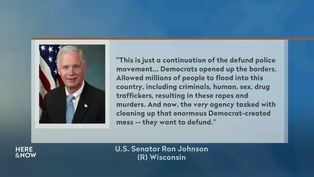
Senator Johnson told This week this is just a continuation of the defund police movement.
Democrats opened up the borders, allowed millions of people to flood into this country, including criminals, human sex drug traffickers, resulting in these rapes and murders.
And now the very agency tasked with cleaning up that enormous Democrat created mess they want to defund, he said when considering Ice enforcement in places like Minneapolis.
What is the intersection between the First Amendment, freedom of speech and assembly and the Second Amendment?
The right to bear arms?
Because Alex Pretti was in the crowd protesting the enforcement surge and carrying a legally permitted gun when U.S.
Border Patrol agents shot him dead.
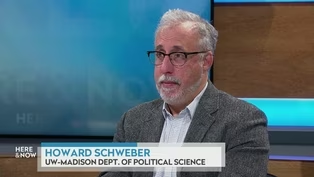
We turn to UW-Madison political science professor and legal scholar Howard Schweber, and thanks very much for being here.
>> Thanks for having me.
>> So in your expertise are crowds like we've seen protesting Ice legally under the First Amendment?
>> There's no straight answer to that question.
That is protected activity, but it can be subject to regulation.
And so for example, there could be permitting requirements.
The crowd could be blocking traffic or any number of specific fact questions could come into play.
There's no question the absolute core of the First Amendment is protecting the right of crowds to gather in protest.
As always, the devil is in the details.
>> What about justifying shooting to kill if someone was legally possessing a gun in the midst of a protest?
Clearly there's a difference between having a weapon and brandishing it.
>> Sure.
So here's where we get, I think, most notably the Kash Patel director of the FBI Kash Patel statement.
You don't have a right to bring a gun to a protest.
Kash Patel statement would get a failing grade in a freshman class in an undergraduate institution.
He is not just wrong.
He is wildly and almost bizarrely wrong.
For someone who occupies a position in law, a senior position in law enforcement in the United States, we should mention the background politics here.
Generally speaking, liberals and progressives don't love the fact that in recent years, the Supreme Court has expanded Second Amendment rights.
Generally speaking, you know, stereotyping conservatives have approved of that expansion.
But there's no question that the Supreme Court has made it very, very clear that you have a right to carry a weapon in public if you are otherwise lawfully permitted to do so.
And the fact that you're at a protest is utterly irrelevant.
The best formulation I've heard I didn't make this up, I wish that I had is we are allowed to exercise two fundamental rights at the same time.
You can engage in First Amendment protest and exercise your Second Amendment rights at the first time, and one does not somehow erase the other.
>> And yet, in the heat of a moment like the like the chaos that we saw in these protests, how difficult is it for police agents, federal agents, to know about that gun and that protester?
difficult.
The video evidence is very, very strong that in this case, the answer is really easy to break it down.
The protesters were not approaching the officers.
protesters.
They crossed space to get to them.
In the absence of any interference or challenge, the officers initiated pepper spraying of the protesters, and Pretti moved to interpose himself between an officer and a woman being pepper sprayed.
He was then grabbed and dragged to the ground, at which point officers discovered his holstered weapon, removed it from him and an officer walked away holding the weapon.
All of this before shots were fired.
So you could have a case where the facts are really complicated, and you could have a case where the police judgment is a close call and has to be debated.
This is not one of them.
The evidence seems absolutely overwhelming that this was in any other context.
This would be a murder.
case be about Alex Pretti without all of that cell phone video?
>> One of the big lessons of these events, and this is not the first time we saw this in the Black Lives Matters protests, we've seen it before is how the ubiquity of video evidence obtained by private citizens using cell phones is changing the conversation.
We would not know what had happened to Alex Pretti without that evidence, we would simply have no idea.
We would have witnesses claiming something.
We'd have the government claiming they were lying.
We're going to be dealing with this for a long time.
We're going to start having to deal with deepfakes and manufactured videos in addition to real ones.
There's all sorts of questions and all sorts of both good and bad possible outcomes that could come from this.
Every person, a journalist phenomenon that we're seeing at the moment, though it is by far the most powerful, if not the only effective mechanism that we have for holding government agents accountable.
>> All of that description of what happened, how dangerous is it for protesters to be on the streets exercising their right to protest?
>> So this morning I had a conversation with someone who was thinking of participating in protest in Madison today and is not going to do so because they're afraid that person may be overreacting or not.
But the the the intimidation and spreading of terror among protesters and potential protesters is not only very real, it certainly appears to be intentional.
And that's the from a constitutional perspective, the biggest point of what's going on here is called the chilling effect.
The police are acting in a way that are causing people to self-censor, to refrain from engaging in speech they're entitled to engage in because they're afraid of what might happen.
And it's very small comfort to say, you know, a year or three down the line, a court might say the police officer was wrong in killing you.
That's not really something that relieves us of that sense of fear.
And from my perspective or in my view, absolutely no question that the operation in Minnesota has crossed that line of chilling effect.
And it's far in the rearview mirror, and these operations are wildly unconstitutional.
>> And now, today, federal agents have arrested two journalists who were covering protests inside a church in Saint Paul.
That's also a chilling effect.
>> It can be this one is a little more complicated, only because there are facts that I don't know.
I think we, the public, don't know.
The facts that we do know are deeply disturbing.
But I think it's clear that the Trump administration doesn't care about getting convictions.
What it cares about is bringing these cases in order to harass journalists and political opponents, to make them reluctant to exercise in, well, in this case, journalism.
Again, I believe that this is this is now purely subjective.
But from looking at the facts that we know thus far, it appears to me that this is an attempt to chill journalists from doing their job, rather than any serious attempt or serious expectation that any criminal charges here will stick.
>> We'll leave it there.
Howard Schweber, thank you very much.
>> Minneapolis is just over the river from western Wisconsin.
Communities like Hudson, where immigration agents are also venturing "Here& Now".
Reporter Erica Ayisi this week took a look at what's happening in Saint Croix County.
>> Someone personally messaged me and they said, Kim ICE is downtown on Main Street taking somebody.
Do you know, can you get a hold of anyone?
>> Kimberly Solberg is a community advocate and one of the moderators of the Baldwin Facebook Community page.
She says Immigration and Customs Enforcement, or Ice, has been in Baldwin since early January.
Solberg says she sprang into action.
>> I started reaching out to what context?
I had to try to find out if people could get a hold of the farm and let workers know, just to be alerted that Ice is in the area, and to make sure that their families are protected.
>> About 4300 people live in Baldwin, where farming is prevalent in this part of western Wisconsin.
>> We have a very thriving, rich and diverse community of Hispanic and Guatemalan people up here working at the farms and being part of our community.
>> Solberg says the immigrant community is working in Baldwin legally.
>> To my knowledge, most of these families are here on work visas.
I know the people that sponsor them.
>> Baldwin is about 50 miles from the intense ice activity in Minneapolis, but Solberg says Ice is active in the area.
Have you seen ice activity here in Baldwin yourself?
>> I've seen clusters of Ice vehicles, maybe almost a dozen vehicles or more clustered together, getting ready to do sweeps at apartment complexes.
>> Were their faces covered?
>> As far as I've seen, they've all, you know, they haven't had their masks on.
And that might just be a different dynamic here in Baldwin, where they feel a little more comfortable here than they do in Minneapolis.
>> Solberg says she's seen local Baldwin police present in Ice raids.
>> I have seen personally local law enforcement assisting Ice and Ice actions, not the actions taking themselves, but they were local law enforcement were present.
>> She was asked to start a group and connected with other organizations to share resources for Baldwin families who are impacted by Ice and afraid to leave their homes.
>> Most of the people I know who give rides, who donate resources are terrified that their name gets out there.
As somebody who is helping.
>> The I-94 bridge behind me connects Hudson, Wisconsin, to the Minneapolis, Minnesota area.
And according to Solberg, it's invoking fear amongst local residents.
She says they've seen Ice agents in Hudson, Baldwin and Woodville.
>> For sure, those actions are going on in neighboring communities.
>> In Hudson, Kiva Sherr says Ice detained an employee during his first day on the job at a grocery store.
>> We have an Amazon drop off and pick up area.
And so ICE went to that particular part of the store and detained an employee there.
>> Schauer says some employees feel they're being profiled.
She and other staff want to help support them if Ice returns, but she says fear takes precedence.
>> Even though I want to be a good person and help, there's that fear of what are they going to do?
Are they going to use tear gas?
>> The darkest time, I'm gonna let it shine.
>> Back in Baldwin, Solberg says the community is holding a vigil for their Minneapolis neighbors, René Good and Alex Pretti, who were killed by Ice.
>> It's about, you know, having a peaceful presence.
>> To help each other heal.
>> And being there for each other.
It shouldn't be about politics.
>> In Saint Croix County.
I'm Erica Ayisi for "Here& Now".
>> This week "Here& Now", senior political reporter Zac Schultz sat down with the two candidates for the Wisconsin Supreme Court election, Appellate Court Judge Maria Lazar and Appellate Court Judge Chris Taylor.
Over the next two weeks, we'll have extended interviews with the candidates.
But this week, we wanted to show you their reactions to some questions about ICE enforcement in Minneapolis.
>> There's obviously a lot of controversy over ICE's engagements in Minnesota right now.
There's speculation that that could be moving to Wisconsin.
What role would the Wisconsin court system have when we've heard some local law enforcement say they will not work with federal officials, some say they will work with when it comes to protesters rights.
How do you see Wisconsin courts getting involved in this, or is this strictly a federal issue?
the circumstances.
You never want to see anyone injured or lose their life.
That's a tragedy in all respects, in every case.
But I think that cooler heads have to prevail.
There is a right to First Amendment freedom of speech, but I also believe that this is an excellent example of why we need our courts.
In this case, it's probably federal courts, but why we need our courts to be fair, impartial and independent, to look at the facts, to make a reasoned, calm decision, and to do so fairly, unjustly.
>> Certainly.
I will tell you, Zach, as I go out around the state, I think that Wisconsinites are really concerned by what they're seeing in Minnesota.
They're afraid, and I don't blame them.
Courts, state courts must make sure that every person who violates the law is held accountable.
So in Minnesota, they should do their full and fair investigation, and then they will make a decision that state about whether criminal charges will be brought and they should be able to do that.
So yes, state courts absolutely could be involved because criminal charges are brought in state courts.
Typically nobody is above the law.
The Constitution applies to everyone.
And so I think that we will see some involvement or potentially see involvement if there are criminal charges filed in the Minnesota state courts.
And that could happen here in Wisconsin as well.
>> And there was a statement by the FBI director, Kash Patel, over the weekend saying, you can't bring a firearm loaded to any kind of protest that you want.
I want to get your reaction to whether that is a true statement, in the sense that the First Amendment and the Second Amendment.
>> I would have no idea what those rules are with regard to federal rules about bringing a firearm.
I think you're violating possibly the Second Amendment, where people have the right to conceal carry their right to open carry.
I wouldn't comment on his statement at all whatsoever.
>> Well, I don't know all of the laws that the state of Minnesota, but I believe they do have a concealed carry law.
So, you know, this investigation of what exactly happened in this scenario will play out and we will find out a lot more, and we will see if Minnesota makes the decision on how they're going to act.
Are criminal charges going to be brought or other charges going to be brought?
But I don't specifically know all the laws in Minnesota.
But what I would say is everyone should support a full and complete investigation into what occurred and if there has been unlawful activity.
People need to be held accountable.
But I want to make sure that Minnesota has that ability to do their investigation and make their conclusions before I jump to any conclusions.
But my gosh, we should be standing in support of them being able to do that.
>> Republican candidate for governor, Josh Schoemann, dropped out of the race after President Donald Trump endorsed Tom Tiffany this week.
Tonight, Zac Schultz talks with candidates about funding for public education and what they would like to see happen with the school voucher program.
>> Calling Wisconsin's school funding formula broken is one of the oldest refrains in state politics, but the sheer number and size of operating referenda around the state show school districts and voters agree the state is not providing enough money.
>> Well, you can't do it without money, and we've been asking schools and teachers to do more and more with less and less and less.
Our kids haven't even gotten an inflationary increase for 15 years.
That to me is unacceptable.
So money is essential.
But it's not only money, right?
Teachers also need professional development time and training and the respect that they deserve.
As professionals, the single most important factor in a kids success is the quality of the teacher at the front of the classroom.
So investing in teacher retention so that we have the most experienced, the most capable, skilled teachers able to stay in the classroom and stay in the education field and mentor newer teachers, I think is absolutely essential.
>> I think, you know, we've got to make sure that we look absolutely at how do we spend more on public education in Wisconsin?
One of the challenges, I think, is that we're still working on a system.
Tommy Thompson took a snapshot of what things looked like in 1993, and we're still looking we're still working with that system 32 years later.
I think it would be courageous and necessary for us to look at exactly what we need to do for 2026 and moving forward, rather than trying to make the best of a 30 year old systems.
>> We used to fund our public schools to the tune of two thirds, and we no longer do that.
And now, not just our teachers, but our young people are hurting every single day.
And I think that we need to actually take a step back.
We need to take a step back and look at not just our revenues, but how we're spending money.
I think that we should put in place a blue ribbon commission on taxes.
This isn't something.
This is something that hasn't happened since the mid 80s.
But this gives an opportunity for university officials to be at the table.
Business leaders, government folks, you know, just the public to have a transparent conversation.
What's working in other states, what can we bring here to make sure that we have a system of revenue and spending that works for everyone and works to the future?
>> The reform is in our inequitable school funding formula that pits communities against one another, that raises property taxes, but also makes it so that the disparities among students, especially those who are lower income, are not being addressed.
And so increasing special education for 90% reimbursement at some sufficient levels and making sure that we're increasing general aids.
Our schools have been defunded for over a decade now, and if we do not prioritize public education, which is one of our last remaining democratic institutions, we as a state will not succeed.
>> We need to make sure that we are investing the money, because what we see all across the state is that there are all of these referendums, and people are voting to increase their own taxes, not to pay for a new science lab, not to pay for a new middle school, but to pay for operational expenses, teachers salaries.
And that is just unsustainable moving forward.
So we have to put more dollars into the public school system, but we also have to look at reform to make sure that kids are getting the education they need to be able to succeed.
>> I'm I would be fine if we put more money into education.
In fact, I expect that we will.
But we need to make sure that it goes to goes to children and families.
We should pay good teachers more, and I think we should reward administrators that are successful in their schools.
We have to get back to where we reward success in education.
And I think that's one of the ways we we fix this problem of us falling behind Mississippi.
And but I'm not averse to putting more money in.
But it there has to be accountability.
>> I believe that every school in the state of Wisconsin can be a world class school, but it takes the investments.
If we can't compare students who have every single need met versus those who have hardly any needs met, we have to invest in the whole child.
And that's the kind of overhaul that I'm looking at, ensuring that all of our students are fed, all of our students are housed, all of our students have the health care, mental and physical health care and make sure that all they have all their needs met.
So when they're showing up to school, they are ready to learn so that when they go home, they have a foundation that retains the education that they got in that school building.
Until we start looking at complete outcomes for all of our children, then the conversation about was, is it funding?
Is it not funding?
It's immaterial.
>> You know, right now we're in this situation where we have said that competition is good.
We decades ago, we decided, you know, competition is going to make our public schools better.
But one thing that we're not doing is looking at the rating of how other schools are doing that are receiving public funds, whether those are charter schools or other types of choice schools.
We need to have a scale that helps us understand how are they competing.
It isn't necessarily that something must be better than public schools.
It's let's have a real accountability.
Make sure our kids are achieving and getting the quality that they need in order to succeed.
>> Wisconsin School Voucher Program was created in the 1990s in Milwaukee and expanded statewide in 2011.
As the cost of the program has grown, the question we put to the candidates is whether it should expand contract or stay the same.
>> I think that we need to look and make sure that we have good accountability and transparency first, before we start making decisions about stopping or starting or eliminating, we need to understand what are they providing for our children and our families, because there are families that are counting on those voucher schools.
But at the same time, it can't come at the cost of public schools, and it can't come at the cost of making sure that we're funding special education.
accountability.
That's the most important thing we can do.
That has to be paramount.
We have to ensure that there are structures in place that don't create a playing field, where some schools operate by one set of rules, and another set of schools operates by a different set of rules.
Any public funding should come with public accountability.
And that's a that's the bottom line.
>> You know, we've had choice in Wisconsin and it's worked for thousands of families across the state of Wisconsin.
And we should continue to have that program.
But I'm a product of public schools as well as my seven brothers and sisters.
All three of my daughters went to public schools up in the Minocqua area, and public schooling has a long, proud history in Wisconsin.
We need to make sure that we have a strong private, public, and parochial system.
Regardless of how you choose to educate, we've got to make sure we have a strong educational system.
absolutely address the voucher system.
We need to make sure that the voucher system is what it was originally intended to do, which was for low income families to be able to have some choices.
And right now we do not have an income limit on the voucher system, and we're going to be taking off the cap for the vouchers.
That is going to be funneling public money into private schools.
We cannot afford to have two separate school systems within the state of Wisconsin.
So we're going to have to have some reform in that area as well.
>> I am very concerned about public dollars going to private schools and a system that is unaccountable and not transparent in how they may or may not be serving our kids.
And so it's critical that we look at a program that seems more and more to be like a scam.
>> I think one, we need to fully fund our public school systems.
You cannot get rid of the voucher system unless our schools are in a place to actually educate all of our students in every community across Wisconsin, and that means fully funding our public school systems.
But any system that is receiving public dollars should be held to the same standards of our public schools.
They need to be transparent, they need to be held accountable, and they need to make sure, again, to be held to the same standards that public schools are held to, no matter what community they're in.
In Wisconsin.
>> The voucher system has now been in place for the last 30 years.
I'm not interested in a dramatic expansion of it, but I also think there's challenges of trying to put that genie back into the bottle.
I think the most fundamental thing for us is around accountability for everybody in education, making sure that we have the right investment in kids and making sure that we're holding ourselves, holding schools accountable for the challenges that we have in education.
But at the same time, you know, as in anything with education, there are lots of problems that come to the schoolhouse door that have nothing to do with what happens inside that schoolhouse.
voucher system brought to a responsible close.
We simply cannot and should not try to fund two different, separate school systems.
Their taxpayer money needs to be accountable to taxpayers, and public dollars should fund the public school system.
>> Reporting from Madison.
I'm Zach Schulze for "Here& Now".
>> For more on this and other issues facing Wisconsin, visit our website at PBS Wisconsin.
Org and then click on the news tab.
That's our program for tonight I'm Frederica Freyberg.
Have a good weekend.
>> Funding for "Here& Now" is provided by the Focus Fund for Journalism and Friends of PBS Wisconsin.
Baldwin, Johnson React to Homeland Security Funding Fight
Video has Closed Captions
Clip: S2400 Ep2429 | 1m 22s | Tammy Baldwin and Ron Johnson on Homeland Security funding given actions in Minneapolis. (1m 22s)
Here & Now opening for January 30, 2026
Video has Closed Captions
Clip: S2400 Ep2429 | 1m 5s | The introduction to the January 30, 2026 episode of Here & Now. (1m 5s)
Howard Schweber on Protesting ICE and Constitutional Rights
Video has Closed Captions
Clip: S2400 Ep2429 | 12m 48s | Howard Schweber on the killings of Renee Good and Alex Pretti and the Bill of Rights. (12m 48s)
Wisconsin's 2026 Governor Candidates Consider School Funding
Video has Closed Captions
Clip: S2400 Ep2429 | 9m 27s | Candidates in the 2026 race for governor on public school funding and choice vouchers. (9m 27s)
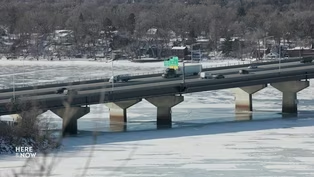
Witnessing — and Fearing — ICE Actions in St. Croix County
Video has Closed Captions
Clip: S2400 Ep2429 | 4m 2s | Immigration raids and protests are weighing upon communities in western Wisconsin. (4m 2s)
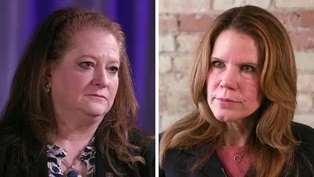
Wisconsin's 2026 Supreme Court Candidates on ICE and the Law
Video has Closed Captions
Clip: S2400 Ep2429 | 3m 56s | Maria Lazar and Chris Taylor on the role of courts concerning Homeland Security actions. (3m 56s)
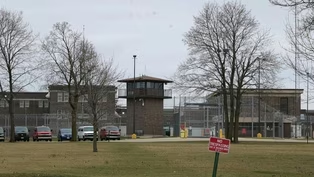
Wisconsin's 2026 Governor Candidates Consider State Prisons
Clip: S2400 Ep2429 | 4m 41s | Candidates in the 2026 race for governor on a plan to overhaul the corrections system. (4m 41s)
Providing Support for PBS.org
Learn Moreabout PBS online sponsorship
- News and Public Affairs

Top journalists deliver compelling original analysis of the hour's headlines.

- News and Public Affairs

FRONTLINE is investigative journalism that questions, explains and changes our world.












Support for PBS provided by:
Here and Now is a local public television program presented by PBS Wisconsin