
February 12, 2026 - PBS News Hour full episode
2/12/2026 | 57m 46sVideo has Closed Captions
February 12, 2026 - PBS News Hour full episode
February 12, 2026 - PBS News Hour full episode
Problems playing video? | Closed Captioning Feedback
Problems playing video? | Closed Captioning Feedback
Major corporate funding for the PBS News Hour is provided by BDO, BNSF, Consumer Cellular, American Cruise Lines, and Raymond James. Funding for the PBS NewsHour Weekend is provided by...
February 12, 2026 - PBS News Hour full episode
2/12/2026 | 57m 46sVideo has Closed Captions
February 12, 2026 - PBS News Hour full episode
Problems playing video? | Closed Captioning Feedback
How to Watch PBS News Hour
PBS News Hour is available to stream on pbs.org and the free PBS App, available on iPhone, Apple TV, Android TV, Android smartphones, Amazon Fire TV, Amazon Fire Tablet, Roku, Samsung Smart TV, and Vizio.
Providing Support for PBS.org
Learn Moreabout PBS online sponsorshipAMNA NAWAZ: Good evening.
I'm Amna Nawaz.
GEOFF BENNETT: And I'm Geoff Bennett.
On the "News Hour" tonight: Immigration operations are set to draw down in Minnesota after months of protests and the killing of two U.S.
citizens.
But how much will really change?
TOM HOMAN, White House Border Czar: President Trump made a promise of mass deportation, and that's what this country's going to get.
AMNA NAWAZ: The Trump administration rolls back landmark climate policy, including greenhouse gas regulations.
GEOFF BENNETT: And world leaders prepare to meet in Germany amid strained transatlantic relations following U.S.
efforts to annex Greenland.
WOLFGANG ISCHINGER, Chairman, Munich Security Conference: I think the Greenland episode has created this question, which is not the foolish question.
Are we still on the same team?
(BREAK) GEOFF BENNETT: Welcome to the "News Hour."
The Department of Homeland Security is barreling toward a shutdown after Democrats refused to budge on a funding bill and lawmakers left Washington for a 10-day recess.
The department's funding is set to expire Friday at midnight.
AMNA NAWAZ: The deadlock comes as President Trump's immigration campaign faced intense scrutiny on Capitol Hill today, and his border czar announced a significant drawdown to its operations in Minnesota.
Lisa Desjardins begins our coverage.
TOM HOMAN, White House Border Czar: Good morning.
LISA DESJARDINS: In Minneapolis, from Tom Homan, a change of course.
TOM HOMAN: I have proposed, and President Trump has concurred, that this surge operation conclude.
LISA DESJARDINS: President Trump's border czar declaring an end to the tumultuous immigration crackdown in Minnesota, which in recent weeks saw a flurry of street arrests, widespread protests, and the killing of U.S.
citizens Renee Good and Alex Pretti by federal officers, and an entire community on edge.
Homan touted the operation as a success.
TOM HOMAN: As a result of our efforts here, Minnesota is now less of a sanctuary state for criminals.
LISA DESJARDINS: He said most agents will relocate, but a small footprint of personnel will remain to enforce immigration laws.
TOM HOMAN: President Trump made a promise of mass deportation, and that's what this country's going to get.
LISA DESJARDINS: But on the block where Mr.
Pretti was killed, skepticism lingers.
PATRICIA WAGNER, Minnesota Resident: I don't have a lot of trust in what is being said by Mr.
Homan and anyone in the administration, to be frank.
COURTNEY ARMBORST, Minnesota Resident: This is just one blue state that is suffering what's happening, and other blue states will continue to be under attack.
And ICE isn't going anywhere.
This is just a stop on their checklist.
LINH NGUYEN, Owner, Mi-Sant Kitchen & Bakery: There's a lot of damages that are left here for us to clean up.
LISA DESJARDINS: Linh Nguyen, who owns a restaurant in the Twin Cities suburbs, said the fear among immigrant communities will be hard to shake.
LINH NGUYEN: We certainly feel that the community itself is probably still very strong, and they will be there, but I don't know.
Long-term impact is hard to say right now.
GOV.
TIM WALZ (D-MN): We are cautiously optimistic.
LISA DESJARDINS: That mixed emotion echoed today by Minnesota Governor Tim Walz.
GOV.
TIM WALZ: The fact of the matter is they left us with deep damage, generational trauma.
They left us with economic ruin in some cases.
While the federal government may move on to whatever next thing they want to do, the state of Minnesota and our administration is unwaveringly focused on the recovery of what they did.
LISA DESJARDINS: Meanwhile, in Washington, today's announcement came as the Senate Homeland Security Committee gaveled in for an oversight hearing.
First to testify, Minnesota Representative and Majority Whip Tom Emmer, who defended ICE.
REP.
TOM EMMER (R-MN): It was heartbreaking, and any loss of life is tragic.
But make no mistake, it was all a direct result of radical sanctuary state and city policies in Minnesota.
LISA DESJARDINS: Lawmakers directed questions at state leaders like Minnesota Attorney General and Democrat Keith Ellison.
KEITH ELLISON, Minnesota Attorney General: We haven't had any cooperation up until now, which is really unusual.
LISA DESJARDINS: He indicated hope for better cooperation with ICE, but said so far they have not seen that on the investigations into the fatal shooting of Renee Good.
KEITH ELLISON: We have been denied access to critical evidence in the case to evaluate it, information like the car, the gun, shell casings, other critical information needed to complete an evaluation and an investigation, we simply haven't had access to.
We hope this changes.
LISA DESJARDINS: Next, the nation's leading immigration officials faced senators... SEN.
RAND PAUL (R-KY): We can roll the video.
LISA DESJARDINS: ... and the video of how their agents acted, as senators played the moments leading up to Alex Pretti's killing frame by frame.
SEN.
RAND PAUL: Is filming of ICE or Border Patrol either an assault or a crime in any way, Mr.
Scott?
RODNEY SCOTT, Commissioner, U.S.
Customs and Border Protection: No, sir.
LISA DESJARDINS: CBP Commissioner Rodney Scott pledged to release officer bodycam video, but declined comment on who was at fault in Alex Pretti's death, citing investigations under way.
SEN.
GARY PETERS (D-MI): This woman's clearly trying to have her back turned, trying to get away.
And he shoves her pretty violently to the ground.
Just looking at that, would you think that that's not de-escalation, or you just say you can't answer that?
RODNEY SCOTT: No, I'm not justifying that action.
I'm saying I don't have enough information in front of me to say it is or is not, because I don't know what happened before this video.
SEN.
RAND PAUL: I think what's important about the encounter isn't even the specifics of the investigation.
It's about, what are your officers trained to do?
LISA DESJARDINS: Scott, as well as acting ICE Director Todd Lyons both indicated that an officer may draw their firearm when the agent believes it's required to do so, including when approaching a stopped vehicle.
Senator Rand Paul, who chairs the committee, urged the agencies to reevaluate.
SEN.
RAND PAUL: You have to look at what your rules are for drawing weapons, because it appears to me they're not using the same standard as the police.
LISA DESJARDINS: Both officials said they never told Homeland Security Secretary Kristi Noem that their assessment of Mr.
Pretti was that of a domestic terrorist.
SEN.
GARY PETERS: How would you possibly come to that kind of conclusion to tell the American public that when they're watching this video?
RODNEY SCOTT: I can't speculate on what someone else would say or why, sir.
SEN.
GARY PETERS: Mr.
Lyons?
TODD LYONS, Acting Director, U.S.
Immigration and Customs Enforcement: Sir, I can't speculate to what the secretary thought at that time, sir.
SEN.
GARY PETERS: So it seems to me a really big question, which means that we have to have Secretary Noem here.
LISA DESJARDINS: For her part, Secretary Noem was in California this afternoon.
KRISTI NOEM, U.S.
Homeland Security Secretary: I know that some of the operations in Minnesota are changing, but we're going to continue to stay focused with our investigators through the Homeland Security Investigations on the fraud that's been going on.
LISA DESJARDINS: Back in Washington, the midterms and whether these agencies will deploy to the polls came up.
TODD LYONS: We do civil enforcement and criminal law enforcement.
There's no reason for us to deploy to a polling facility.
LISA DESJARDINS: Michigan Democrat Elissa Slotkin argued there's reason to believe they could.
SEN.
ELISSA SLOTKIN (D-MI): It's not fantasy.
It's not made up.
These are things that the president and his Cabinet have suggested.
If we do not have serious reform and change, then you will be contributing to the average American who woke up very supportive of law enforcement being terrified that they and their community will be next.
LISA DESJARDINS: But the future of any reform and of agency funding are now unclear.
SEN.
RAND PAUL: The hearing is now adjourned.
LISA DESJARDINS: For the "PBS News Hour," I'm Lisa Desjardins.
AMNA NAWAZ: We asked the White House for an interview with border czar Tom Homan about the end of the operation in Minneapolis.
The administration declined our request.
For an on-the-ground perspective, I'm joined now by special correspondent Fred de Sam Lazaro, who's been covering the crackdown in the Twin Cities.
So, Fred, you are standing at the memorial to Renee Good in Minneapolis.
As you talk to folks, tell us about the reaction that you're hearing about this announcement, to this announcement that ICE has begun to withdraw.
FRED DE SAM LAZARO: Amna, you got a flavor for that reaction in the voices you just heard.
I think the reaction ranges from guarded relief to deep skepticism.
A lot of people are not quite ready to exhale yet.
AMNA NAWAZ: Sounds like a sort of wait-and-see approach for folks there.
And we should note Tom Homan said the ICE withdrawal could stretch into next week or even beyond.
So what are you still seeing in the way of ongoing ICE operations?
And what should we know about the thousands of people who were arrested as part of this enforcement operation?
FRED DE SAM LAZARO: There are a number of citizen groups in the Twin Cities who monitor what they call ICE sightings.
And many of them are saying there's been no diminution in the amount of activity that they see.
Some of them are reporting a drop in that kind of activity.
As for the people who've been detained, many of them transferred to facilities in Texas, from the few who've been released, there's anecdotal reports of abysmal conditions, of crowded places, crowded spaces, not enough space to sleep, and, most importantly, the lack of access to their lawyers.
Now, Tom Homan and the Department of Homeland Security insist that these facilities are fine.
In their words, they're better than many prisons that are incarcerating American citizens.
AMNA NAWAZ: Fred, you and your team have reported so deeply on the many aspects of daily life that have been disrupted as part of those ICE operations, people afraid to leave their homes, afraid to get medical care.
It's also had a big impact on schools.
Tell us more about that.
FRED DE SAM LAZARO: A profound impact, Amna.
We spent a day yesterday in an elementary school from where about a fifth of all pupils are absent on any given day.
A few of them are from families that have been taken by ICE.
A few others have actually self-deported, but most of them are attending virtually.
Many of the students who are attending, the teachers say, are traumatized, worrying about what's happening to their absent classmates, where they are, worrying also and reflecting of what they have seen and heard.
And so there is real concern about the long-term impacts that these will have psychologically on these children and, in fact, their ability to learn, which is deeply diminished right at the moment.
AMNA NAWAZ: Yes, and we heard some of that from Governor Walz, right?
He talked about the generational trauma from the ICE raids.
Mayor Frey said too that the raids had been catastrophic for these communities.
So how do people on the ground begin to heal?
FRED DE SAM LAZARO: That is the all-important question that we may start to see answers for in the weeks and months ahead.
That, of course, depends on what the enforcement looks like in the weeks and months ahead.
Economically, from all accounts, this has been a huge, huge deal.
We have seen many immigrant-run businesses decimated by this, many small businesses that rely on immigrant labor, the restaurant business, long-term care facilities, the construction industry also decimated.
At the state level, they could possibly provide about $10 million, and that needs to be approved by the legislature.
And that's a drop in the bucket from what economists say will be needed.
It's reminiscent to many people of what happened to small businesses during the pandemic, with one important difference.
And that is the spigot of federal dollars that poured billions into local economies, that's not an option anymore.
AMNA NAWAZ: That is Fred de Sam Lazaro reporting on the ground in Minneapolis.
Fred, thank you.
FRED DE SAM LAZARO: Thank you.
GEOFF BENNETT: And turning our attention back to Capitol Hill, our Lisa Desjardins joins us now.
So, Lisa, let's start with this expected DHS shutdown.
What's the latest?
LISA DESJARDINS: We are heading toward a shutdown.
It is all but certain now.
While the deadline is tomorrow night, tomorrow night at midnight, East Coast time, Congress has left town.
Senators are gone, and for a 10-day recess now, and some of them even going overseas.
Now, the central issue here remains the same.
It is about ICE reform and funding DHS.
Where we are is that Republicans and Democrats just don't think they're even close enough to compromise on that to stick around.
So they're giving up on that deadline at least for now.
Now, Democrats say Republicans and the White House specifically have not put enough on the table for them to even engage in serious talks right now.
However, Republicans see this differently.
I caught up with majority Leader of the Senate John Thune.
SEN.
JOHN THUNE (R-SD): I have seen significant movement on the part of the administration on some of the key issues.
LISA DESJARDINS: Which are?
SEN.
JOHN THUNE: Well, I'm not going to litigate that publicly.
I think that right now both the White House and Senate Democrats have done a pretty good job of keeping those conversations in a forum where they can have an honest back-and-forth.
Clearly, right now, we're not at a place where there's a deal, but I think a deal is in sight.
LISA DESJARDINS: Of course, I asked Thune, so why are you leaving?
This is a shutdown.
This will really affect thousands of people.
He said he just doesn't think they're close enough.
There's not a deal in sight right now.
But there are other senators who are not going on CODELs, those trips overseas, like Mike Rounds.
He says he's going to stick around.
But right now there's really no reason to think they're going to reach a deal in the next couple of days.
GEOFF BENNETT: So how firm are Democrats in their demands, which is another way of asking, how long will this shutdown last?
LISA DESJARDINS: This is the question that tens of thousands of people, especially those working for DHS, want to know.
I will give you the honest, blunt answer.
No one knows how long this could go, which means it could go long.
We don't know.
Sometimes, a rainbow appears in the Senate.
I will give you two points of view, one for optimists.
I know many of our viewers are optimists.
They could look at this and say, there are real talks going on here.
The White House and Senate Democrats are engaging on some level, which is unique in the past year, let's say.
So there's reason to hope.
Also, they're not negotiating through the press.
We don't really know what the terms are here.
You know as well as I do, the less is said, the more chances there are for a deal.
Now, for the pessimists out there, we have some of those viewers too, I'm told.
The problem here is that there really is a rift over immigration policy that is going to be hard to square.
This is a midterm election year.
The politics here are very sharp.
Both sides have bases defending the outward position here.
It's going to be hard for them to move forward.
But one example, I talked to Gary Peters, senator from Michigan, who you know is often a pragmatist.
This is where we are.
I asked him, how close are we in the offers?
And he just told me point blank: "We still have a long ways to go."
That was a couple hours ago.
So we could be here for a while.
GEOFF BENNETT: And people can be forgiven if they're confused by this, because, if memory serves, DHS got $195 billion in the last Trump spending bill, $75 billion alone just for ICE.
So there are people who I'm sure would ask, what difference does it make if they don't have a funding bill?
They already have all this money to spend.
LISA DESJARDINS: Your memory is 100 percent correct.
They have billions of dollars for ICE and CBP.
They don't have to worry about this.
We have talked about this before this week, what this shutdown would mean.
But, tonight, I want to look at it in a little bit of a different way, the sheer size of this agency.
Let's talk about Homeland Security, since it's the only agency that will be affected.
Now, this is an agency that has 272,000 employees.
That's larger than most towns that our viewers live in.
Of that, roughly 23,000, according to their plan for the last shutdown, would be furloughed, meaning they would stay home.
The rest, that's well over 90 percent, would be on the job.
Now, ICE and CBP, as you're saying, could be paid from this big pot of money they have.
But let's talk about the larger concerns.
There are real concerns about TSA and the Coast Guard.
Those two groups and most of the federal workers involved will be paid.
They just are getting paid this week.
So what that means is perhaps the next incentive point is two weeks away, when they will be missing some pay perhaps.
Congress is gone.
So I think we can sort of read how this could go.
There's hope for a deal maybe while they're gone, but not much.
It's that incentive and TSA that could be the next pressure point.
GEOFF BENNETT: Lisa Desjardins, a busy day for you and our politics team.
Our deep appreciation.
LISA DESJARDINS: You're welcome.
GEOFF BENNETT: In the day's other headlines: A federal judge temporarily blocked the Pentagon from punishing Arizona Senator Mark Kelly for participating in a video that called on troops to resist unlawful orders.
District Judge Richard Leon ruled that officials violated Kelly's rights and -- quote -- "threatened the constitutional liberties of millions of military retirees."
The retired Navy pilot sued the administration after he was censured last month and threatened with a demotion and cut in retirement pay.
Speaking to reporters today, Kelly called the ruling a critical moment and lashed out at President Trump.
SEN.
MARK KELLY (D-AZ): However this thing ends, I'm going to stand up to him and stand up to this administration, because what they are doing is not right.
GEOFF BENNETT: Defense Secretary Pete Hegseth says the Pentagon will appeal today's ruling.
It comes just days after a grand jury refused to indict Kelly and five other Democratic lawmakers over their appearance in the video.
Democrats on a U.S.
Senate committee criticized this week's closure of the El Paso airspace, saying real communication issues led to the unprecedented shutdown.
SEN.
MARIA CANTWELL (D-WA): Yesterday's incident at El Paso reminds me of why this interagency coordination is so important.
GEOFF BENNETT: Lawmakers on the Senate Commerce Committee pointed to a lack of communication between the FAA and the Pentagon for the closure.
At issue were Pentagon plans to test a laser to shoot down drones used by Mexican drug cartels.
It's believed the target turned out to be a party balloon.
The head of the NTSB also expressed her shock at the lack of coordination at today's hearing.
JENNIFER HOMENDY, Chair, National Transportation Safety Board: I will say there has been miscommunication or no communication between at least the Army and FAA for years.
The lack of communication even within a large agency and between agencies is terrible.
I don't understand it.
People can't talk?
It's astounding to me.
GEOFF BENNETT: Homendy was called to testify to the committee about the NTSB's findings on last year's air collision between an American Airlines jet and a military helicopter that killed 67 people.
Today's hearing focused on a long-running NTSB recommendation that aircraft be equipped with multiple location systems that some believe could have prevented the tragedy.
House Democrats are looking to build on momentum against President Trump's tariffs after lawmakers voted last night to roll back levies against Canada.
The rare bipartisan vote must go to the Senate next, and President Trump can veto the measure, but it could open the door to further votes that would target other tariffs, like those on Mexico and Brazil.
Speaking to reporters today, House Democratic Leader Hakeem Jeffries said the tariff policies must stop.
REP.
HAKEEM JEFFRIES (D-NY): We're in an extraordinary situation right now where Republican policies led by Donald Trump and House GOP members are actively hurting everyday Americans.
GEOFF BENNETT: President Trump has threatened lawmakers of his own party who vote against the tariffs, writing on social media last night that anyone who does would seriously suffer the consequences come election time, and that includes primaries, he says.
And there was global reaction today to the Trump administration's policies, starting in India, where farmers in trade unions mounted a one-day nationwide strike against a trade deal with the U.S.
Protesters say the framework agreement would flood the market with cheap products and threaten the livelihoods of millions of small farmers.
The government has defended the deal, saying it would lower tariffs and deepen ties with the U.S.
Closer to home, two Mexican Navy ships carrying humanitarian aid arrived in Cuba today, as the U.S.
blocks oil supplies from reaching the island.
President Trump has threatened tariffs on countries that supply oil to Cuba.
Officials there say the energy crisis is getting worse.
A federal judge in Florida rejected an attempt by the BBC to delay proceedings in a $10 billion lawsuit brought by President Trump.
Instead, the judge set a trial date of February of next year.
Mr.
Trump sued the broadcaster in December over the editing of a speech he gave on January 6, 2021, shortly before some of his supporters stormed the U.S.
Capitol.
The BBC apologized to the president, but denies it defamed him.
On Wall Street today, stocks tumbled amid concerns about the negative effects of A.I.
on the business world.
The Dow Jones industrial average fell nearly 670 points on the day.
The Nasdaq dropped nearly 500 points, or about 2 percent.
The S&P 500 saw its worst day since November.
We turn now to the Winter Olympics and the fate of a Ukrainian athlete who has been barred from competing due to his helmet.
Vladyslav Heraskevych says it honors more than 20 athletes and coaches who have been killed since Russia invaded his country.
The International Olympic Committee found that the helmet breaks rules against political statements in competition and disqualifies him.
The Ukrainian flag bearer says he does not entirely understand what regulations he violated and that he hopes to appeal the decision.
VLADYSLAV HERASKEVYCH, Ukrainian Olympian: I just want to memorialize my fellow athletes.
I want to be part of Olympic Games and to compete and try to get my chance to win a medal.
GEOFF BENNETT: As for today's action, a warning, we have some spoilers ahead.
Team USA star snowboarder Chloe Kim finished with silver in the women's halfpipe, falling just short of a third straight Olympic gold.
Some heavyweights hit the ice in men's hockey, with the U.S.
and Canadian teams both winning.
This is the first Olympics in 12 years to allow NHL athletes to play for their home countries.
As for the medal leaderboard, the U.S.
is now tied with Norway for second overall with 14 medals apiece.
Host country Italy leads all nations with 17.
And 54-year-old curler Rich Ruohonen is now the oldest American to ever compete in a Winter Olympics.
The personal injury lawyer from Minnesota subbed in late in today's match against Switzerland.
He got a standing ovation, saying his dream came true.
Still to come on the "News Hour": what scientific discoveries an expedition to Antarctica is revealing, despite setbacks; European and American leaders convene, as global alliances shift; and how theater is helping Ukrainian children facing Russia's relentless bombardment.
AMNA NAWAZ: The Environmental Protection Agency has repealed its own landmark Obama era assessment that greenhouse gases threaten public health and welfare.
Public health and environmental groups warn, today's changes could lead to many more premature deaths and arise in asthma attacks in the coming decades.
Until today's shift, which is expected to be challenged in court, the so-called Endangerment Finding has been the legal foundation for many of the federal government's climate regulations.
William Brangham has more, and it's part of our ongoing series Tipping Point.
WILLIAM BRANGHAM: Amna, the EPA first made that assessment in 2009 after an exhaustive review of the scientific evidence which showed that greenhouse gases were dangerously warming the planet and exacerbating extreme weather events and air pollution.
Under the Clean Air Act, that meant the EPA was then obligated to regulate that pollution.
But, today, President Trump called that finding a scam that had no legal or scientific basis.
His EPA administrator, Lee Zeldin, called it the single largest act of deregulation in American history.
LEE ZELDIN, Environmental Protection Agency Administrator: The 2009 Obama EPA Endangerment Finding is now eliminated.
This action will save American taxpayers over $1.3 trillion.
What that means is lower prices, more choices, and an end of heavy-handed climate policies.
WILLIAM BRANGHAM: Environmental advocates warned that this would worsen public health and deal a major blow to any attempts by the U.S.
to lessen the impacts of climate change.
For more on today's announcement, we are joined now by Maxine Joselow.
She's a climate reporter for The New York Times.
Maxine, thank you so much for being here.
This original finding came out of a Supreme Court ruling, Massachusetts v. the EPA, which said, yes, you can consider carbon pollution a pollutant, but you have to prove that it's detrimental to human health, which the Obama administration did.
Since that time, how has the Endangerment Finding been used by the federal government?
MAXINE JOSELOW, The New York Times: That's exactly right.
And the Endangerment Finding did not in and of itself set any new climate regulations, but it formed the legal and scientific basis for those regulations.
And, in particular, the Obama EPA used it as the justification to set the first limits ever on greenhouse gas emissions from cars, trucks, and eventually from power plants that burn coal or natural gas to make electricity.
And in the intervening years, there's been a back-and-forth between Democratic, Republican administrations, a weakening and a strengthening of those rules.
But they have remained in effect and as that litigation has played out.
WILLIAM BRANGHAM: So, now with that Endangerment Finding gone, what happens now?
MAXINE JOSELOW: So, today, EPA said that not only were they repealing the Endangerment Finding, but they also said they were immediately repealing all greenhouse gas limits on cars and trucks.
So that's already happened.
And then, in the coming months, EPA said it plans to repeal additional limits on greenhouse gases from power plants and other sources as well.
WILLIAM BRANGHAM: The science that undergirded that first finding has not changed.
In fact, the National Academies last year said, not only is the science of that original finding accurate, but it's in subsequent years become more evident.
How does the administration justify this current move?
MAXINE JOSELOW: So, Lee Zeldin, the EPA administrator, said that the Obama administration in 2009, when it issued the Endangerment Finding, used more dire predictions of how much the planet would warm than it actually would.
And, in some ways, that is true.
In 2009, the Obama administration cited some extreme projections of warming that are no longer as likely to happen because the world has taken some climate action, some efforts to reduce emissions and improve the deployment of renewable energy.
That being said, the science was unequivocal in 2009 that greenhouse gases were causing climate change, and that was unleashing more frequent and severe heat waves, floods, other extreme weather events.
And in the past 16 years, the science has only grown more unequivocal, not less.
WILLIAM BRANGHAM: The -- Zeldin also said that this was about saving money.
And we know that the White House is concerned that voters are concerned about energy prices right now.
But he and the president both said that this would really make prices for things cheaper, specifically, like cars getting $3,000 cheaper.
Does your reporting show that there's evidence for that?
Have these regulations cost Americans and will getting rid of them make things cheaper?
MAXINE JOSELOW: Great question.
Affordability is obviously a big concern for voters and a big topic for both political parties right now.
And we saw Karoline Leavitt, the White House press secretary, in the briefing this week also claim that this action would save about $2,400 off the cost of a new car for the average consumer.
And Lee Zeldin and President Trump both repeated that figure today.
The experts that I talk to, though, I had them go back and review the EPA's proposed rule and the math and the calculations that the agency did in that proposal.
And they said that the agency relied on some false and misleading assumptions to reach that $2,400 figure.
So one thing that assumed was that gas prices would be lower in the future, but they didn't explain why they thought that.
And they also didn't account for really rapidly declining costs of batteries used in electric vehicles.
And those are just two examples.
The experts I talked to went on and on.
And they also said that it's not just about the total cost of ownership of a new vehicle.
It's also about the fuel cost.
And more efficient vehicles save you money on gas because you're filling up less often.
WILLIAM BRANGHAM: Right, over the long run.
This move comes as the evidence of a warming planet just grows.
2025 was I think the third hottest year on record, surpassed only by 2024 and 2023.
What do environmental advocates say will be the likely result of this move?
MAXINE JOSELOW: They say this is going to essentially take the U.S.
out of the fight to combat climate change at a time when, as you said, the impacts are only growing more clear, from the wildfires in Los Angeles last year, to the flooding in Texas that claimed dozens of lives.
Those climate disasters are going to continue and accelerate, and the U.S.
government will no longer be playing any role in attempting to contain that.
WILLIAM BRANGHAM: You and your colleague Lisa Friedman had a story recently indicating that the Trump administration wants this to get to the Supreme Court.
Why is that?
MAXINE JOSELOW: The Trump administration is moving very quickly with this repeal of the Endangerment Finding.
They did it in just about a year, which may not feel fast to you and me, but in the world of slow-moving regulations, that's very fast.
And they're doing that because they want to have this litigated in federal court and then at the Supreme Court while Trump is still in office.
And that's important, because then his lawyers at the Justice Department can defend this before the Supreme Court.
If, say, a future Democratic president were to take office when this got to the court, then that Justice Department probably wouldn't defend this rule.
WILLIAM BRANGHAM: I see.
Maxine Joselow with The New York Times, thank you so much for being here.
MAXINE JOSELOW: Thanks so much for having me.
GEOFF BENNETT: As the Trump administration pulls back from regulations on climate change, many scientists remain worried about the warming of the oceans, glaciers and sea level rise.
Our science correspondent, Miles O'Brien, has been reporting from Antarctica on a major mission to understand what's happening there.
In his latest report from the Thwaites Glacier, he looks at other key research projects that have been part of that trip.
MILES O'BRIEN: The timing was awkward.
New York University glaciologist David Holland and I landed on the Thwaites Glacier almost precisely when the valiant effort to bore through it and install a suite of sensors in the ocean beneath reached an unceremonious dead end.
MAN: Stuck.
DAVID HOLLAND, New York University: We did not succeed in doing what we wanted to do, was to put a weather station in the ocean out there to begin to monitor it.
What we achieved there was nothing, absolutely nothing, a little bit Shakespearian.
MAN: Damn, that's brutal.
MILES O'BRIEN: The tragedy became comedy when Dr.
Holland asked me to give him a hand, which, as an arm amputee, is literally all I had to offer.
But I have a hard time saying no.
OK, these are empty.
Just my speed.
All right.
Let's go!
What are you doing?
Are you doing your end?
DAVID HOLLAND: That's dragging.
No, I think that one is just dragging.
MILES O'BRIEN: All right.
So we started setting up the distributed temperature sensor, the last instrument slated to go down the hole.
The heavy gear connects to a fiber-optic cable that provides continuous temperature readings from the surface to the seafloor.
But now it will come up about 650 feet short.
Once the hole closed up, you could have closed up shop and just come back to the ship, but you didn't.
DAVID HOLLAND: Why?
So it shows the possibility of what we can do in terms of remote instrumentation.
So it would be sugarcoating to say that's really great.
I would say that's better than nothing.
MILES O'BRIEN: The drill project was the marquee event of a monthlong scientific campaign launched from the deck of the icebreaker Araon owned by the Korea Polar Research Institute, or KOPRI.
Despite the drilling failure, they notched some success.
One of the helicopters flew for several days over the ice, surveying with a powerful radar able to peer through the thick ice to measure it and see what the lay of the land is below.
Now in its sixth year, the research campaign is a partnership between KOPRI, the University of Texas, and Montana State University.
CHRIS PIERCE, Montana State University: So they have been out for, what, six hours now, a little over six hours.
MILES O'BRIEN: The field team leader is glaciologist Chris Pierce.
They logged more than 1,800 miles of straight lines up, down, and across the glacier over six flight days.
The trio of long booms contains the radar antennas.
They send long wavelength radio signals downward and then listen for the echoes.
The elapsed time of their return defines details beneath the surface.
CHRIS PIERCE: We have got really good-quality data and we have got really good coverage coming out of this.
MILES O'BRIEN: He showed me one of their radargrams.
It's a two-dimensional slice of the ice, like an MRI or X-ray, understanding the terrain beneath the ice is a priority for researchers, developing models to predict how fast the glacier might retreat.
CHRIS PIERCE: Once you get past a certain point, you're going to have a really, like, low-friction surface on which the glacier can slide.
So that's one of the reasons that people believe that Thwaites is particularly susceptible to instabilities.
MILES O'BRIEN: To help calibrate his radar, Pierce turns to sea ice scientist Siobhan Johnson of the British Antarctic Survey to get a precise read on the density of firn, snow that is transitioning to ice.
She is an expert in ice coring.
We were on top of Thwaites when she showed me how it's done.
So, a little easier than doing it manually.
SIOBHAN JOHNSON, British Antarctic Survey: Yes.
Yes.
MILES O'BRIEN: So, let's give it a try and see how it goes.
SIOBHAN JOHNSON: Yes?
MILES O'BRIEN: She uses a coring device attached to a cordless drill.
Easy peasy.
This core represents about six months of firn.
It tells a story if you know how to read it.
Clear ice means a warm spell.
SIOBHAN JOHNSON: Oh, actually you see a little here.
MILES O'BRIEN: Oh, yes?
SIOBHAN JOHNSON: It's got some melt layer.
Do you see?
MILES O'BRIEN: Oh, yes, I do.
I do.
When she cores sea ice, she cuts a precise section, then weighs it to determine its density.
In 2016, sea ice here began a sharp and unexpected drop as the climate crisis changes wind and ocean currents.
Melting sea ice does not directly raise sea level since it's already floating.
But its loss can indirectly accelerate the melting of land ice, glaciers like Thwaites.
SIOBHAN JOHNSON: The cover of the sea ice in this area is quite important for ocean heat transport, which will melt the underside of the Thwaites.
MILES O'BRIEN: The role of sea ice in glacier melt forecasts is one of a myriad of uncertainties this expedition was designed to help unravel.
The team deployed and recovered moorings that collect underwater data profiles over multiyear periods.
They made frequent stops to measure the ocean's salinity, temperature, depth, currents, and chemical composition.
And they launched and retrieved an autonomous underwater glider carrying profiling instruments on a multiday mission.
But perhaps the most novel approach was this, a device called RIFT-OX.
Polar geophysicist Jamin Greenbaum of the Scripps Institution of Oceanography at U.C.
San Diego, teamed up with helicopter maestro Dominic O'Rourke to fly into ice canyons on a series of daring missions.
JAMIN GREENBAUM, Scripps Institution of Oceanography: So, at Thwaites, we can take advantage of the fact that it's collapsing and producing these rifts that allow you to get to places that in other glaciers you just can't get to.
MILES O'BRIEN: RIFT-OX is lifted by helicopter and flown to a fractured rift.
It breaks through thin ice and lowers a rosette of canisters as deep as 2,800 feet.
They capture water samples at prescribed depths.
They're looking for telltale signs of subglacial discharge.
Formed under the glacier by geothermal heat and friction as the ice slides over the rock, it squirts into the sea, where it mixes with warm ocean water.
JAMIN GREENBAUM: You know, I like to think of the warm ocean as like the fire.
And this subglacial discharge, I like to think of it like lighter fluid that's getting sprayed into the fire, and it just -- it just blows the whole thing up.
MILES O'BRIEN: His early data have confirmed this hypothesis.
JAMIN GREENBAUM: And, lo and behold, in area three we see direct evidence of subglacial discharge.
So it really is exactly where we thought it might be.
MILES O'BRIEN: Wow.
It's all hard-won data.
KOPRI is vowing to return in two years.
The puzzle pieces are elusive and the hard work here moves at the pace of a glacier.
But this one, the most consequential of them all, is moving faster than efforts to understand it.
For the "PBS News Hour," I'm Miles O'Brien at the Thwaites Glacier.
AMNA NAWAZ: Ahead of Europe's largest annual security conference, NATO defense ministers gathered in Brussels today to calm nerves and stiffen spines after President Trump's threats to Greenland roiled the alliance.
Here's Nick Schifrin with more.
NICK SCHIFRIN: Today, an alliance recently shaken by American threats hosted a reunion to portray itself a happy family.
NATO defense ministers met in Brussels and provided words of encouragement and reassurance, including to themselves.
BORIS PISTORIUS, German Defense Minister: USA are a member of NATO, and they will remain a member of NATO.
But to keep -- in order to the keep the NATO -- to NATO transatlantic, it is necessary to make it more European.
MARK RUTTE, NATO Secretary-General: Good to see you.
NICK SCHIFRIN: Europization of NATO, exactly the message from the Pentagon's number three, Elbridge Colby.
ELBRIDGE COLBY, U.S.
Undersecretary of Defense for Policy: And I think we have a really strong basis for working together in partnership, but putting NATO, kind of a 3.0 NATO that's based on a partnership, rather than dependency.
NICK SCHIFRIN: Today, the U.S.
says it provides nearly half of NATO's military posture and wants to provide less than one-third within about five years, especially as it prioritizes its own borders, Venezuela and the rest of Latin America, and China, whose military buildup is the fastest in world history.
As Colby told the defense ministers in a closed-door briefing: "We will continue to provide the U.S.
extended nuclear deterrent.
But Europe should feel the preponderance of the forces required to deter and if necessary defeat conventional aggression in Europe."
It's a message the Trump administration has sent consistently, but today's delivery was with a perhaps more constructive tone than one year ago today.
PETE HEGSETH, U.S.
Defense Secretary: We're also here today to directly and unambiguously express that stark strategic realities prevent the United States of America from being primarily focused on the security of Europe.
NICK SCHIFRIN: And last month.
DONALD TRUMP, President of the United States: The United States is treated very unfairly by NATO.
I mean, we have helped them for so many years.
We have never gotten anything.
And all we're asking for is to get Greenland, including right, title and ownership, because you need the ownership to defend it.
You can't defend it on a lease.
NICK SCHIFRIN: President Trump's implicit military threat against Greenland has passed.
But it sparked a new NATO plan called Arctic Century to boost surveillance and presence near Greenland and across the Arctic.
MARK RUTTE: We will also build a more cohesive picture of potential challenges in the Arctic, so that any gaps can be quickly and effectively addressed.
NICK SCHIFRIN: But across Europe and ahead of a key security conference in Germany, the Greenland hangover is lasting and sparking a fundamental question.
Is the U.S.
a reliable ally?
Here in Munich, world leaders are descending on the annual Munich Security Conference, one of the world's key diplomatic gatherings.
And this year, the annual Munich Security Conference report calls this period -- quote -- "wrecking ball politics" and the U.S.-led post-1945 international order -- quote -- "under destruction."
To talk about that and preview the conference, it is a pleasure to welcome Wolfgang Ischinger, former German ambassador to the United States and chairman of the Munich Security Conference.
Ambassador, thanks very much.
Welcome back to the "News Hour."
WOLFGANG ISCHINGER, Chairman, Munich Security Conference: Great to be here.
NICK SCHIFRIN: The report says this - - quote -- "The most powerful of those who take the axe to existing rules and institutions is U.S.
President Donald Trump."
How deep has that axe already cut, do you think?
WOLFGANG ISCHINGER: Well, pretty deep.
I think we are, to a certain extent, in trouble when I think about those on this side of the Atlantic who have firmly believed that there is such a thing as the West.
We, together, Americans, Europeans, facing our adversaries, I think a certain limit of trust has been at risk, has been lost in this period.
I admit, I'm the first to admit that there are many things that we did not do as early as we should have done.
NICK SCHIFRIN: We being Europeans, Germans, yes, NATO.
WOLFGANG ISCHINGER: We, all Europeans together, led by the big ones, including first and foremost Germany itself.
We have not taken seriously.
I remember you had a defense secretary by the name of Gates a decade ago.
NICK SCHIFRIN: Bob Gates, yes.
WOLFGANG ISCHINGER: More than a decade ago.
He said, this is not sustainable.
You guys, Europeans, you need to do more in defense.
NICK SCHIFRIN: Right.
WOLFGANG ISCHINGER: We ignored it.
So that's our fault.
But we're now faced with an unprecedented security situation.
I'm not sure Americans understand to what extent people here live in fear.
There is a war going on at our doorstep.
This is longer than World War I. And I think Germans are terrified by the pictures we get daily on our television screens from Kyiv, from Odesa, from other cities about these people are freezing to death.
NICK SCHIFRIN: How much has the president's threats about Greenland tipped the balance, if you will, about this European concern and lack of faith in the United States?
WOLFGANG ISCHINGER: Well, I think the Greenland episode has created this question, which is not a foolish question.
Are we still on the same team?
Has the United States come to the conclusion that Europe -- that the European Union is actually not a good idea in terms of U.S.
interest?
NICK SCHIFRIN: And President Trump has called the E.U.
a foe for many years.
WOLFGANG ISCHINGER: Exactly.
Do we need to brace ourselves against -- for a situation where the European Union, as such, with all its bureaucratic rules and et cetera, is under threat?
NICK SCHIFRIN: Under threat from the United States?
WOLFGANG ISCHINGER: Under threat from the United States.
NICK SCHIFRIN: As you know and as the report acknowledges, the Trump administration has achieved a lot when it comes to world affairs.
NATO spending, for example, is up to 5 percent.
You have a Gaza cease-fire that even members of President Biden's administration admit they probably couldn't have achieved.
And also we now have post-Greenland more of an emphasis on security in the Arctic.
And as Stephen Miller put it recently, the U.S.
- - quote -- "are living in the real world" that is governed by strength, governed by force, that is governed by power.
So the Trump administration thinks this is just reality and they're succeeding.
WOLFGANG ISCHINGER: I don't dispute that.
I would be the first to say he's probably right.
We live in a world of carnivores, and -- but we come from a different world.
We are now relearning the hard way that, if you want to be successful in this world with an aggressive Russia, with an increasingly authoritarian global power approach from China, we need a diplomacy that is underpinned, like the United States demands from us, with sufficient military power.
That's a new lesson for us to learn.
NICK SCHIFRIN: Is that history why Germany, perhaps more than most European countries, feel this break, if you will, with the United States?
A new Politico poll out today says 50 percent of Germans do not believe the United States is a reliable ally, because, as you know, there are divisions within Europe.
I talked to Eastern Europeans who basically say, and some Northern Europeans, including the secretary-general of NATO, Mark Rutte, say, look, good luck if you're going to do this without the United States.
We still need the United States, and we still feel kinship to the United States because we need their security.
WOLFGANG ISCHINGER: Yes, I think the truth of the matter is, we are so worried because we know that we can't do this without the United States.
We would be helpless in terms of the nuclear threat if we didn't know there are U.S.
nuclear weapons in Germany, and there are airplanes equipped to carry these nuclear weapons in terms of presenting a credible, extended nuclear deterrence picture to the other side.
NICK SCHIFRIN: Is the U.S.
nuclear deterrence not reliable, or at least not as reliable as it used to be?
WOLFGANG ISCHINGER: I see no reason why there should be any doubt about this.
The weapons are there.
I have not heard from anyone in the United States that this is being questioned.
NICK SCHIFRIN: Yes.
WOLFGANG ISCHINGER: But if and when the United States correctly asks of us to do more about our collective defense effort in Europe, I think we should not automatically totally exclude the nuclear question.
NICK SCHIFRIN: Should the French be allowing their nuclear weapons to be considered for collective European defense, something that they have never done before?
WOLFGANG ISCHINGER: I think they're - - we're far from that point, but I think it is not a stupid idea.
I think it's an important idea for us in Europe at least to examine such questions in detail.
We will not only boost our conventional defense.
We're also looking at to what extent and, if so, how we could conceivably bolster our European component in the nuclear.
(CROSSTALK) WOLFGANG ISCHINGER: It is not written in the Bible that 450 million Europeans need 350 million Americans to defend themselves against 140 million Russians.
If we spoke with one voice more to China, also to Russia, we could probably be a more respected international actor, we, as members of the European Union, than we currently are.
NICK SCHIFRIN: Ambassador Wolfgang Ischinger, chairman of the Munich Security Conference, thanks very much.
WOLFGANG ISCHINGER: Thank you.
GEOFF BENNETT: In just over a week, Ukraine will mark four years since Russia's full-scale invasion started.
And now, in the depths of a frigid winter, under constant bombardment and a near-constant power blackouts, it may seem there is little space for art or joy, especially for children.
AMNA NAWAZ: But in the Eastern city of Kharkiv, there's a small corner a half-a-century old where children can learn the grace, the discipline, and, yes, even the joy of theater.
Special correspondent Jack Hewson takes us there for our arts and culture series, Canvas.
JACK HEWSON: For 50 years, Theater Timur has been a place where children come to play and perform together.
Rehearsals look much like they always have.
In Kharkiv in Ukraine's east, everything around them has changed.
Since Russia's invasion, practice now takes place under the constant threat of bombardment, predominantly from Iranian-made Shahed drones.
For 17-year-old Maria, the theater has become more than just a stage.
MARIA GORKAVTSEVA, Performer, Timur Theater (through translator): At the beginning of the war, all my friends left and I had nothing to do.
I was scared to stay at home alone.
And I found out that there was a children's theater in Kharkiv.
I didn't know about it at all.
I came and saw that there were a lot of children here.
They were all having fun, playing.
And I knew that if anything happened, they would save me because there was a shelter here.
JACK HEWSON: Teenagers rehearse alongside adults, learning discipline, trust, and how to hold their nerve in a city under attack.
When Russia invaded, the arts were sidelined as the nation scrambled to defend its border.
For director Anton Zhiliakov, it's about resilience, thriving, not just surviving.
ANTON ZHILIAKOV, Director, Timur Theater (through translator): We understand that first and foremost now is the front, the army, and everything related to it.
But I believe that in second place should be art, theaters, and so on, because that should also be what we were fighting for, not only the fight for our freedom, but then what we do with this freedom, about our identity, about our culture.
JACK HEWSON: The performances shown here from the theater's archive footage lend a greater weight for audiences strained by the emotional toll of war.
They bring moments of lightness, reflection and simple escapism.
ANTON ZHILIAKOV (through translator): Many people tell us that, at your performances, we cried out our pain and it becomes easier for us to live.
Someone says that, at your performances, we forget that there is a war going on around us, and for this hour or two it is also very important for us to get our minds off things.
JACK HEWSON: Suddenly, we hear the sound of a drone overhead.
ANTON ZHILIAKOV (through translator): I need to get the children down urgently.
You also go down, down to the shelter now.
Let's go.
Everyone to the shelter now, this second.
Let's go to the vault, this second.
Quick, let's go now to the vault.
JACK HEWSON: Anton doesn't hesitate.
Everyone must be brought down underground as soon as possible.
All these kids have just had to come downstairs into this basement because a Shahed was heard overhead in the middle of an interview we were just doing.
This is pretty much a routine occurrence.
They're straight on their phones.
This is normality for them now.
But it's just insane that this is what they have to deal with multiple times a week, multiple times a day even.
This is normal life for children in Kharkiv.
But as normal as this has become, harrowing individual stories are quickly revealed.
Sviatoslav is just 15.
SVIATOSLAV OLHOVSKYI, Performer, Timur Theater (through translator): A rocket flew over our house recently and then a rocket hit the house next door.
JACK HEWSON: You're very young to be experiencing things like this.
It's crazy.
How does it affect you?
SVIATOSLAV OLHOVSKYI: It's hard.
That is so crazy, but it's not good, no.
JACK HEWSON: Childhood here is lived under constant threat, and yet continues against all odds.
Theater Timur has arguably never been more important.
The children it serves, Anton believes the theater is playing its most vital role yet.
ANTON ZHILIAKOV (through translator): Now, visiting the theater, they mentally survived.
But time will pass.
And, paradoxically, I'm sure that these memories will be some of their happiest, how during the war they played Christmas plays for the whole city in this bunker.
We are very alive here in Kharkiv.
This is our message to the world.
JACK HEWSON: As the air raids continue, this basement has become one of the few places where happy childhood memories can still be made.
For the "PBS News Hour," I'm Jack Hewson in Kharkiv, Ukraine.
GEOFF BENNETT: And there is more online, including the 2,000-mile journey that a group of monks took from Texas to Washington, D.C., to advocate for peace.
That's on our YouTube page.
AMNA NAWAZ: And, of course, join us again here tomorrow night for the analysis of David Brooks and Jonathan Capehart.
And that is the "News Hour" for tonight.
I'm Amna Nawaz.
GEOFF BENNETT: And I'm Geoff Bennett.
For all of us here at the "News Hour," thanks for spending part of your evening with us.

After protests and backlash, Minnesota ICE surge set to end
Video has Closed Captions
Clip: 2/12/2026 | 6m 32s | After deaths, protests and political backlash, ICE surge set to end in Minnesota (6m 32s)

DHS barreling to shutdown after lawmakers fail to reach deal
Video has Closed Captions
Clip: 2/12/2026 | 4m 32s | Homeland Security barreling to shutdown after lawmakers fail to reach funding agreement (4m 32s)
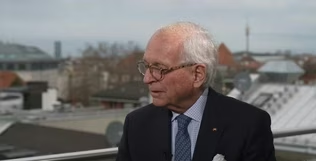
Ischinger asks if Trump, NATO 'still on the same team'
Video has Closed Captions
Clip: 2/12/2026 | 7m 7s | 'Are we still on the same team?' Ischinger asks as Trump fuels NATO tensions (7m 7s)

News Wrap: Judge blocks Pentagon from punishing Sen. Kelly
Video has Closed Captions
Clip: 2/12/2026 | 6m 38s | News Wrap: Judge blocks Pentagon from punishing Sen. Kelly (6m 38s)

Some Minnesotans skeptical as feds say ICE operation ending
Video has Closed Captions
Clip: 2/12/2026 | 4m 7s | Some Minnesotans skeptical as feds say immigration operation winding down (4m 7s)

Strained U.S. ties loom over NATO ahead of security summit
Video has Closed Captions
Clip: 2/12/2026 | 2m 49s | Strained U.S. ties loom over NATO leaders ahead of Munich Security Conference (2m 49s)
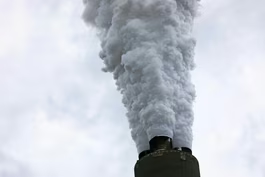
Trump rolls back policy regulating greenhouse emissions
Video has Closed Captions
Clip: 2/12/2026 | 8m 4s | Trump rolls back landmark policy regulating greenhouse emissions (8m 4s)

Ukrainian theater provides joy for kids facing Russia's war
Video has Closed Captions
Clip: 2/12/2026 | 5m 18s | Ukrainian theater provides joy for children facing Russia's bombardment (5m 18s)
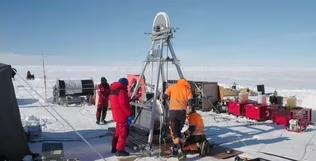
What researchers learned at Antarctica’s Thwaites Glacier
Video has Closed Captions
Clip: 2/12/2026 | 7m 52s | Despite setback, researchers uncover new findings at Antarctica’s Thwaites Glacier (7m 52s)
Providing Support for PBS.org
Learn Moreabout PBS online sponsorship
- News and Public Affairs

FRONTLINE is investigative journalism that questions, explains and changes our world.

- News and Public Affairs

Amanpour and Company features conversations with leaders and decision makers.












Support for PBS provided by:
Major corporate funding for the PBS News Hour is provided by BDO, BNSF, Consumer Cellular, American Cruise Lines, and Raymond James. Funding for the PBS NewsHour Weekend is provided by...