
Okra From Another Mother
Episode 3 | 25m 21sVideo has Closed Captions
Savers tastes Georgia okra seed oil and Motherland okra green.
Are we eating the wrong part of okra? Kevin Mitchell worries that okra’s rich nutritional benefits are lost to those wary of its sliminess. The Savers travel Georgia seeking better uses. In Pitts they taste okra seed oil at Oliver Farms. In Milledgeville, at Comfort Farms, they meet Jon Jackson’s Motherland Okra, grown for its greens. Chef Kevin prepares African-style okra leaves with smoked fish.
Problems playing video? | Closed Captioning Feedback
Problems playing video? | Closed Captioning Feedback
Okra From Another Mother
Episode 3 | 25m 21sVideo has Closed Captions
Are we eating the wrong part of okra? Kevin Mitchell worries that okra’s rich nutritional benefits are lost to those wary of its sliminess. The Savers travel Georgia seeking better uses. In Pitts they taste okra seed oil at Oliver Farms. In Milledgeville, at Comfort Farms, they meet Jon Jackson’s Motherland Okra, grown for its greens. Chef Kevin prepares African-style okra leaves with smoked fish.
Problems playing video? | Closed Captioning Feedback
How to Watch The Savers of Flavor
The Savers of Flavor is available to stream on pbs.org and the free PBS App, available on iPhone, Apple TV, Android TV, Android smartphones, Amazon Fire TV, Amazon Fire Tablet, Roku, Samsung Smart TV, LG TV, and Vizio.
Providing Support for PBS.org
Learn Moreabout PBS online sponsorship(Kevin) Did you know we've been eating the wrong part of the okra?
Learn about all the beneficial parts of okra and discover a mysterious okra, one that's not slimy, but it is slippery.
♪ (David) In every heirloom seed lies a story of survival, of resilience, a flavor forgotten by the modern world.
Join Charleston chef Kevin Mitchell and me, food historian David Shields on our mission to preserve the long lost flavors of the South.
We are "The Savers Of Flavor."
♪ (Kevin) Ahh.
This is my favorite vegetable, okra.
The pods are like fingers pointing to heaven.
Okra is a vegetable.
With history and controversy.
Brought to America from Africa during colonial times, it became a staple in southern cuisine, whether fried, stewed in gumbo, or even okra soup.
The okra that came over centuries ago is different than this okra here.
The old okra had small white spines or stiff hairs that grew on the pods.
These ripped up the fingers of pickers and cooks.
So in the mid 1930s, plant breeder, R.A.
McGinty of Clemson took smoother varieties, crossed them and created the Clemson spineless okra.
There are things about this okra that should be noted.
The pods are elongated and should be picked under five inches to avoid becoming woody.
Every part of the plant the pods, leaves, seeds is edible, loved by some but avoided by others for his infamous slimy miss.
The slippery texture, however, is packed with nutrients, aiding indigestion and offering anti carcinogenic benefits.
Discover the qualities of this heaven-pointing vegetable that might just change your mind.
♪ (David) Kevin, you got us going on an okra quest today.
What's the story?
Do you, find clues as to the whereabouts of the legendary, slimeless and spineless okra?
The one that, New Englanders can eat without making a face?
(Kevin) Oh, yes, my friends.
There is a mysterious okra out there.
However, we have to make a stop.
First destination is going to be down in Pitts, Georgia.
(David) Kevin, I know that you've always had a thing for okra.
I like okra, too, particularly, low country okra soup.
I like okra fried in cornmeal, but, what about okra rings your bell?
(Kevin) Okra is probably the most important ingredient in the African diaspora.
We know it comes from Africa.
(David) So it's a cultural thing?
(Kevin) It is a culture thing, right?
So it's this connection, for me as an African American.
Right And on a personal level, it connects me to growing up with my grandmother, who was teaching me how to cook at a very young age.
(David) And now, how old are we talking about?
(Kevin) We're talking six years old.
But she would always make a pot of stewed okra and tomatoes and serve it over rice.
Whenever we talk about okra, my mind always goes back to that.
But for us, of course, most importantly, the flavor.
(David) Flavor is traditionally in cultures is linked with nutrition and when you think about the nutrition of okra, it's got a lot going for it.
It's got fiber, it's got into oxidant, folic acid galore, vitamins A, K, (Kevin) Okra is a superfood.
(David) I remember listening to a radio lecture, I guess, by a food chemist from Texas named Herman Kresse.
He asked, why are we nibbling on the immature pods when the plant hasn't even extracted the maximum nutriment out of the soil?
He said it was the seeds that we should be looking at.
Kresse had other fish to fry.
He was a sort of food visionary of sorts.
He was going to take okra seed oil and the mash and reconstitute it into imitation meat.
I mean, Kresse was one of these people that hit upon impossible meat, that two generations before we encountered it.
(Kevin) But we still need to lean into this, the slippery conversation, right?
I think in all cuisines, there's a slippery element.
(David) Yeah, I agree with that.
(Kevin) But for our quest, we're talking, the slippery from oil.
(David) Yes.
Every culture has oil.
(Kevin) And okra seed oil has nutrition multiplied.
(David) Most oil these days, is modeled on canola oil, which is odorless, virtually colorless and tasteless.
It's like, a blank that can be inserted into every recipe.
(Kevin) We're going to visit our friends at Oliver Farm, and they produce oils that are very flavor forward.
Chefs of the South praised this oil for being a prized finishing oil.
(David) So you tell me this is okra seed oil that tastes like okra?
(Kevin) Exactly.
(David) I believe it when my tongue tastes it.
On to Pitts!
(Kevin) On to Pitts!
♪ (David) The town of Pitts, Georgia, is just over 150 miles from Atlanta, where the Oliver family farm has been operating for over four generations.
Operating a number of crops, and The Station, their family store downtown, specializing in cold pressing of variety of oils, all beginning with sunflowers.
♪ Clay, I love the photographs of your dad and your granddad working this land.
How did the transition take place between what they were doing and what you're doing?
(Clay) That's right Dave, we've been blessed to be here many years on this land.
And you know, Grandpa and them did things the way most people did in the South at that time, growing the crops that they did, taking them to market.
But in 2008, when the economy tanked, I had the idea to make a biofuel on something that I grew here on the farm, and that was from sunflowers.
And through that idea, you know, the Lord just opened doors and created a path for me.
Somebody one day said, food grade oil and boom, you know, a light bulb went off.
And that's how I kind of got down this path of making culinary oils instead of biofuel.
(David) So when did the inspiration for okra hit you?
(Clay) Honestly, I saw a Facebook post between you and Glen Roberts where I believe he was doing something with the little tabletop press.
And I said, if he can do it with a tabletop press, I know my machines should do it.
And I just sought out that day to find some seed.
And, I think I went to my local hardware store, bought whatever they had left to plant in people's gardens and crushed it.
(Kevin) So I'm really interested.
So are you willing to show us the process?
We're gonna press some oil for some seeds?
(Clay) You want to go to the oil shop?
You better believe it.
Yeah.
So let's do it.
Let's go.
(David) It's always interesting to me that the most unassuming people from the smallest towns, like Clay and his family farm here in Pitts, Georgia, are often the biggest innovators, whether it's out of necessity, ingenuity or a genuine love of the land.
His turnkey plant to oil business is one of a kind.
Clay, I see you've got one of your screw presses all rigged up here.
Could you talk us through the procedure of turning, okra seed into oil?
(Clay) Sure, David.
Yeah, what we're going to do is pour the commodity, in this case, okra seed into the hopper here.
(David) Using an American made three horsepower press meant for crushing hard grape seeds, Clay slowly raises the temperature on the okra seeds in order to extract the oil below.
So for a like a pound of okra seed, how much oil can you extract from that?
(Clay) This is running slightly less than 10 percent oil.
It's drier than than typically what we normally get.
Got to be patient with okra.
There's not much oil in it.
It's super hard but it's delicious.
(Kevin) It's amazing how no part of the okra plant is wasted here.
The extracted seeds are turned into flour and other products.
Now let's head back to The Station to finally have a taste.
♪ (David) Well, Valerie, thank you for inviting us here to taste the range of your products.
(Valerie) Absolutely.
Let's start with pumpkin seed oil.
(David) It's an interesting color that you have there.
Almost purple.
(Valerie) It even has, like, an iridescent green color when you tilt it ♪ in the bottle.
Cheers!
♪ (Valerie) What do you think?
(Kevin) A little nutty, a little earthy.
It's got a little touch of sweetness to it, which is something I really like.
(Valerie) Next is sunflower oil.
(David) I'm expecting to taste the radiance of the sun here.
(Valerie) You can taste the field.
Yeah.
This is an award winning oil right here.
It's won two good food awards.
(Kevin) I can tell why.
You definitely get the, like that robust sunflower seed flavor with it.
It's also kind of neutral, too.
(David)Now the one that we've traveled cross-country to taste.
(Kevin) Yes.
(Valerie) Okra.
To me, this taste, I don't know, just so fresh and springy.
(David) You know, there was no such thing as okra seed oil before you pressed it.
(Valerie) Yeah.
To me, it has a nice consistency to the oil.
(David) Wow.
All of the spring, wholesome freshness of the green okra, captured in this wonderful sunny lipid here.
I'd be sort of curious to try some of the okra oil on this sliced tomatoes I see over there.
(Valerie) Sliced special for you guys.
Help yourself.
(Kevin) taste the summer right here.
(David) Kevin, you want to try it first?
♪ (Valerie) Nothing like a fresh tomato.
(David) Nothing.
The acid in the oil, it's like, it's dressing itself, you know?
(Valerie) Yep.
(Kevin) Can't go wrong with okra and tomatoes together.
(Valerie) Never.
(David) You know, there's been a lot of, hubbub in the news about, the healthfulness of seed oils and the one thing that I have to observe is that for thousands of years, people in various cultures across the the globe have been consuming these as part of their natural health dosage.
(Valerie) That's right.
♪(David) And, I see nothing wrong in continuing that practice.
Thank you so much.
(Valerie) Thank you all for coming.
(Kevin) Thank you.
♪ (David) Okay, off to Milledgeville.
(Kevin) Yes, sir.
(David) I love Comfort Farm, where Jon Jackson is.
Are you telling me that Jon's growing something special?
(Kevin) Is growing something very special and you'll be very surprised and very happy when you see it.
(David) Well, my eyes are hungry.
♪ (Jon) Welcome.
How's it going?
(Kevin) How are you?
(Jon) Chef Kev, good seeing you, man.
(Kevin) Good to see you.
How you been?
(Jon) Doing great.
The infamous David.
Good to see you guys.
Thank you for coming.
(Kevin) Thank you for having us.
(David) It's great to drive into Comfort Farm.
(Jon) Oh, yeah.
(Kevin) So, tell us about Comfort Farms and the mission.
(Jon) On May 8th, 2010, my ranger buddy, Captain Kyle A. Comfort, got killed in battle.
And, it was a pivotal moment, for me.
I had a lot of my Ranger brothers, and even also with the third I. D. where I started were killed, I decided, because my own injuries at war that I would do something, outrageous, which was start a farm.
I didn't know anything about starting a farm, but I knew I needed to fail at something every day.
So, farming, that's it, right.
That failure leads to the success.
It leads to resilience the same way that we go to battle.
(Kevin) I'm getting, like, therapy vibe.
(Jon) Yeah.
Veterans believe that they're here to help the community.
And then the community believes they're here to help the veterans.
And I just step away.
The magic is right in that process.
(David) A lot of challenges in farming, too.
I mean, if you want stress and ordeal, insects, weather and, worrying about hurricanes and that sort of stuff.
(Jon) That's it.
This is the profession to be in.
(Kevin) So, yeah, I've been telling David about this magical okra that you grow here.
And he's... (David) I like magical okra.
(Kevin) He's excited.
I'm excited.
So can you take us through?
Show us around a little bit?
(Jon) Yes.
Let's go ahead and do that.
(David) Okay.
Up that way?
(Jon) Yes.
(David) It's awful green around here.
It looks like you've had more than your fair share of rain this season.
(Jon) Yes, yes, yes, yes, yes.
(David) See you got the deer fence, surrounding that area.
That must be where all the treasure is.
(Jon) Yes it is.
We got a bunch of stuff in there that all the deer want to eat.
(David) What you're growing?
(Jon) Well, we're growing Motherland Okra.
(David) Abelmoschus esculante (Jon) Yes, yes!
We're growing that.
We're growing some sweet potatoes.
We're growing some hibiscus, the red hibiscus and the white hibiscus from Senegal.
We're going to try to hand out that and try to do our best growing historical and regionally significant food here.
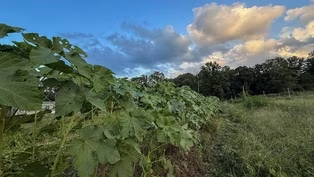
Guys, here we are at Motherland Okra.
(David) And look at that leaf, completely different than the spindly leaf you see on a Clemson spineless.
This is as big as my face.
(Jon) Yes.
And they do get bigger.
She's been struggling this year due to a lot of climate stuff and deer pressure, but she wants to grow.
I call that Motherland Okra because they are from my mother's land in Liberia, where she was born.
We worked with Baker Creek in order to have seeds go out.
The coolest thing about this okra was that there were people from Nigeria and throughout the interior of Africa that said this was the okra that the grandparents had and they lost it.
I think that's one of the best stories about preserving seed as possible.
So taste it, Kev.
(Kevin) Oh, wow.
(Jon) Yes, absolutely.
(Kevin) It's a little sweeter.
It's good.
It's good.
I mean, I really like the fact that it's got that little sweetness to it.
And it's really tender.
(David) And you can eat these leaves raw, too.
(Jon) Yes, yes.
Absolutely.
The best part of this really is and why this plant was developed from antiquity, are the leaves.
♪ Hey, guys, welcome to our farmers market.
(Kevin) Thank you.
(Jon) Yeah.
Awesome.
This is where we engage our community.
We do a lot of stuff here.
We have our local meats and also our heirloom vegetables.
We kind of set it up like a sushi menu where they look at what we got, and then we go pick it fresh from the field, and we do it about twice a month every other Saturday.
(David) I notice that you have seeds as well as fresh vegetables and fruits.
(Jon) Absolutely.
(David) Do you let the pods dry down on the stalks and then pick them and knock them out?
(Jon) Right.
No.
Great question, Dave.
Traditionally, the pod on stalk has to dry, right?
But we get into this El Nino season with the dry pods, with the rain comes down, and then the seeds get moldy.
So what I've been doing is as soon as I see, like, a hint of brown on them, I cut the stalks down and then we hang them, and then they've been able to dry on the actual stalk underneath cover.
So I've been able to take them out, have them dry, and do the same out in the field too, and getting pretty good results.
(Kevin) Yeah, let's see some seeds.
(Jon) All right.
So, this is the pre what they look like before they actually darken.
(David) Oh.
(Jon) And then you can see the contrast when they actually dry out what they look like.
(Kevin) How long does it take from this to this?
(Jon) As soon as they start to brown, you're looking at a couple of weeks for them to get from that to this.
But that's going to be one of the fat pods that are, like, very woody and fibrous.
That's when they're going to start to, do their thing.
(David) Well, it's wonderful that you're saving these seeds and making them available to the community.
You know, I guess it goes without saying, you are a saver of flavors.
Here's your contribution to greater good.
(Kevin) Welcome.
Welcome to the family.
(Jon) Yes.
Well, thank you, man.
I appreciate that.
♪ (Kevin) Today we're making two dishes.
The first is a refreshing okra slaw salad and okra leaves and smoked catfish.
As we were walking through the farm telling me how you can eat these leaves raw.
So, I came up with this really cool idea.
I make this collard slaw.
So instead of the collards, we're going to use the okra leaves in his place.
So what we do is we start with the okra leaves.
What I do is I macerate them in some olive oil.
But what I did here, which is really cool, we use some of the okra seed oil we got from Clay.
So we macerate the greens in that oil.
So we'll let these sit here and then we'll make a quick dressing, apple cider vinegar, about a quarter cup or so.
♪ And we're not going to put oil in this because the oil is already in here.
(David) Got that.
(Kevin) And then we're going to just take lemon.
So a little squeeze of lemon.
A little celery seed.
One of my favorites, a little smoked paprika, a little pinch of salt, some sugar.
Stir that up a little bit.
(David) Got that paprika look there.
(Kevin) And then we're going to just use some whole grain mustard.
You can use Creole mustard if you want.
We'll let that sit for a second here, but then emulsify.
Then I'll bring this back here and then the rest of the ingredients, we're going to throw in some very thinly sliced Vidalia onions.
Fold those in.
And we have some rainbow carrots here.
some chiffonade of little green cabbage.
(Jon) Okay.
(Kevin) Nice and cold.
Nice and crisp.
Just kind of mix this up a little bit.
Very colorful.
Yeah.
♪ Then we're going to take our dressing.
♪ So that's nice and mixed up.
And now we're on a plate.
Cheers.
Cheers.
Our plates.
Right.
Cheers.
There you go.
♪ (David) You're right.
There's no sharpness.
No bitterness.
Actually, I think they taste better than collards in terms of the slaw.
(Jon) Definitely paying tribute to Motherland okra and eating it in like, green form.
Chef, this is absolutely great to kind of show the diversity of this, of this vegetable of the Motherland, you know, especially in West Africa.
So, outstanding.
Great.
Thank you.
Thank you.
(Kevin) While there's nothing wrong with Clemson's spineless okra, its dominance across America's sea catalogs proves its popularity.
But Jon's persistence and his love of home have revived something far rarer a taste of history itself.
Now it's time to tackle a more traditional dish featuring okra leaves and smoked catfish.
♪ All right, so now I'm going to take you home.
(Jon) All right.
(Kevin) So palm oil, okra seed oil, nice and hot.
I'm gonna throw in some onions.
I like that sizzling sound.
The sound of the gods right there.
Saute this up a little bit.
Let the onions, cook down until they're just about translucent or opaque so you can kind of see through.
I'm just going to add just a little bit of salt here.
the salt is going to draw out some of the, the natural moisture in the onions.
Let this cook down a little bit.
Just a couple turns of fresh cracked black pepper.
I'm not going to add too much because we're going to get a lot of spice from these peppers that you gave me right.
And then, I do have underneath here, srimp nd crawfish.
(David) I notice, that there is no sugar here on the table.
(Kevin) No, sir, no, sir.
(David) You're not the type of person that puts that spoonful of sugar in the greens.
(Kevin) I do not put sugar on my greens.
And then also, I'll probably cause a little bit more controversy.
I do not put sugar in my grits.
(Jon) Well, I put sugar in my grits.
They always get on me for that.
(David) Well, that's 'cause you're from New Jersey.
(Jon) Right.
(Kevin) Well, I'm from New Jersey too, so.
Right here I got my onions where they need to be.
I'm gonna add all my greens.
Right.
So we're just going to braise these down.
What's really great is kind of the natural moisture from the greens.
(David) And you won't have to cook this a tremendous long time.
(David) No.
No.
A little slipperiness which which is great.
Add just a touch more water to this.
(Jon) Chef, the aroma just alone, and I know you still working that dish, but you're doing it just the way how West Africans do it.
You're building that pot.
You know, each ingredient goes in, you're giving it the flavor, doing it, what it needs to do.
(David) Is this the way your mother in Liberia does.
(Jon) Oh yes, yes, yes, yes.
It's a labor of love, really.
(Kevin) For those vinegar purists, just a little splash of apple cider vinegar.
Oh, no.
We gotta, We gotta throw in the catfish.
(Jon) You gotta throw in the catfish.
(Kevin) So we'll just break this up.
So nice big pieces.
Because you want to see it, right.
You want to see the fish in there.
Now we're going to dish this up.
Got some cooked Carolina gold rice.
(David) Now did you cook that with some okra oil in there too?
(Kevin) Sure did.
(David) Oh there you go.
(Kevin) Sure did.
(Jon) My grandmother would be proud.
(David) Kevin, this looks splendid.
♪ (David) Got that kick to it.
(Jon) And it's delicious.
(Kevin) Did I do Mama proud?
(Jon) You did, man.
Good.
That's delicious.
(David) Yeah, a lot of flavor.
To the motherland and to the mysteries of okra.
Yes.
Cheers.
Awesome.
Cheers.
♪ (David) I want to read a poem that was published in The State Newspaper in my hometown of Columbia, South Carolina, in 1914.
It was called "Okra Soup."
When days are dark and trouble lowers, and flowers, leaves and spirits droop, What force Revivifies our powers?
That panacea, Okra soup!
For what do Charleston children cry, after measles grip or croup, Far, far more than for pap or pie or mellen's food?
Blest okra soup!
Let Boston rave on pork and beans to such a mess I would not stoop.
Gumbo is the dish for New Orleans, Charleston murmurs, "Okra soup!"
What term, O, prince, shall I apply to him who sneers at okra soup?
His maudlin ravings I defy!
I designate him nincompoop!
Okra soup.
♪ ♪ ♪
Okra From Another Mother Preview
Video has Closed Captions
Preview: Ep3 | 30s | Savers tastes Georgia okra seed oil and Motherland okra green. (30s)
Providing Support for PBS.org
Learn Moreabout PBS online sponsorship
- Food
Christopher Kimball’s Milk Street Television
Transform home cooking with the editors of Christopher Kimball’s Milk Street Magazine.






Support for PBS provided by: