
A Wave of Nostalgia
Season 2 Episode 10 | 23m 17sVideo has Closed Captions
A high school football team steps out of its own shadow.A writer travels historic Route 66.
A small-town high school football team struggles to step out of its own shadow. A writer travels an iconic stretch of Route 66.
Problems playing video? | Closed Captioning Feedback
Problems playing video? | Closed Captioning Feedback
Production Support Provided By: Riptide Waters LLC; Texas Parks & Wildlife Foundation; Texas Rural Funders, H-E-B”
A Wave of Nostalgia
Season 2 Episode 10 | 23m 17sVideo has Closed Captions
A small-town high school football team struggles to step out of its own shadow. A writer travels an iconic stretch of Route 66.
Problems playing video? | Closed Captioning Feedback
Where to Watch Texas Monthly Presents: The Story
Texas Monthly Presents: The Story is available to stream on pbs.org and the PBS app.
Providing Support for PBS.org
Learn Moreabout PBS online sponsorship- Sometimes there's a negative connotation with nostalgia.
Stop talking about the glory days.
- It's okay to honor the past, but let's start setting our own path.
- History tells us who we are.
- Hi, okay.
- That's why we wear the number 22 sticker on our helmets.
- Let's not back down, okay?
- Nostalgia is the fuel that keeps these stories as alive and pulsing thing.
(light dramatic music) History tells us who we are, who we were and who we are.
I mean, it's, it's vital.
Somehow I end up writing about kind of vague history or semi-forgotten history or surprising bits of history.
Route 66 is centennialist this year, so I decided to go up to the Panhandle and see the road for myself.
My name's David Courtney.
I'm a senior writer at Texas Monthly, and I wrote "Route to the Past."
Smells like West Texas.
- [Camera Crew member] What is it?
- It's cattle, or a byproduct of cattle.
Route 66 holds such a place in American culture.
Whether it's one little spot on the road or whether it's the road as a whole entity, it was one of the first highways to connect the midsection of the country to the West Coast.
But Route 66 was decommissioned in, I believe, 1985.
All along Route 66, there are a number of ghost towns, many of which were the result of being bypassed by I-40.
One of the towns I went to was Jericho Gap.
A few years ago, a couple from Amarillo, the Schaffers, purchased the town, and they've just done an amazing job at preserving it.
- As y'all know, this was the old Route 66, and it's just County Road B now.
It's not old Route 66.
- With Route 66 coming in, this little town thrived, and families were spending the night, they were spending money here, they were buying from the locals.
- Moved the traffic off the road, and the little town just goes away.
So we had Route 66 being moved in 1936, and we had the Dust Bowl and the Great Depression, and I lost over half my population, and just continued going down.
- [David Courtney] Historic preservation is important.
Without their efforts, these places would disappear and future generations would have no tangible evidence of Route 66.
- It's a younger generation that's traveling Route 66, and they want to know the stories.
- What do you think the allure of Jericho is to travelers?
- I believe it's because it's listed as a ghost town, and people want to come in and see the old ruins and what's left, and what they leave with is a story.
- [David Courtney] It was just great to see a younger set telling these stories from a hundred years ago about this little community that were literally just forgotten.
All along the way, you see these abandoned gas stations and motels.
- Hello!
- [David Courtney] But among the very few businesses and the most thriving is the Midpoint Cafe.
Just a classic roadside diner.
- I'm sorry, honey, you're good, thank you.
Okay, I have a sweet tea.
Who has a sweet tea?
- [David Courtney] I was very surprised at how busy it was.
- Bye, Reid.
Love you.
Thank you.
Thank you.
Tell your wife I said happy Mother's Day also, okay?
I love my people.
- I know you do.
It's obvious.
It's very obvious.
- I love my people, they're so awesome.
- It's obvious.
Why is it called the Midpoint Cafe?
- Because it's halfway between Chicago and Santa Monica.
- Exactly, halfway?
- Exactly.
Yeah.
- Painted out there on the street.
- Painted out there on the street, yeah.
- [David Courtney] It's this bustling center of activity in Adrian.
It was heartening to see the level of activity and interest there.
- Yeah, we had 84 countries come through and we sold over 1500 pies last year.
- 1500 pies?
Impressive.
- [David Courtney] Brenda Hammit, the current owner of the cafe, who's been there, I think she started in the kitchen decades ago, is just a character, a real powerhouse.
- Oh, it's been a blast already this year.
I've had so much fun.
I mean, is it, I'm old, so it's kind of kicking my butt a little bit, but it's okay.
- [David Courtney] It's the people like Brenda who make Route 66 a living thing.
Each little place you stop or each person you get to talk to, that's a piece of the larger story.
Vega's another little town along Route 66 that was bypassed by the interstate.
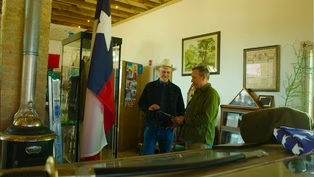
The Milburn Price Culture Museum is a popular stop.
You open the door and walk in and it's just this amazing collection of Panhandle and American artifacts.
- To me, it's just a means for people to come through our town.
It's a means for people that are still excited about it.
It gets them into our community.
This building used to be a hardware store built in 1926, same age as old Route 66.
And we started this in 2014 to become a museum.
Now the week that we started, stuff started walking through the door.
People heard of what we were going to do, and it hadn't hardly stopped in 12 years.
Stuff still comes through the door.
- And the visitors you get, they're from all over the world, aren't they?
- All over.
We had people from Portugal.
We have people from Pakistan a couple of days ago.
Just 90 or 100 countries have been through here since we've opened up, and it's just amazing the people from overseas that travel Route 66.
It's like a ultimate bucket list of them because they can see a broad slice of Americana.
We tell them, "You're in the best part of Route 66 right now because we love Texas," and then we try to show them a good time and help them feel that."
- [David Courtney] It was really cool to get to talk to someone who'd grown up in the area.
- My granddad came here in 1910 with his mom and dad.
I was four years old when my granddad died, but I've got a lot of his things and that's my connection to him because everything has a story.
- [David Courtney] Nostalgia plays a big part of what Route 66 is now, but as evidenced by the people I met along the way it's a living, ongoing endeavor.
A lot of the businesses you see have been long abandoned, so to have these little bright spots in these little towns that have, you know, maintained and held on and thrived, it's great to see.
I love history because it's just constant discovery or rediscovery.
You're learning about a place or a people or the a way people interacted with a place.
It's who we are.
- Sometimes there's a negative connotation with nostalgia.
There's this sense that you shouldn't be living in the past.
Stop talking about the glory days.
(crowd cheers) - [Commentator] Touch down.
- [Commentator] That is the ball game.
Fort Hancock Mustangs win the state championship trophy.
- But in the case of Fort Hancock, the nostalgia is the exact thing that keeps the current program afloat.
When I arrived, they hadn't won a game since 2021.
My name is Jordan Ramp and I wrote a piece about the Fort Hancock Mustang's football team for Texas Monthly.
(train whistles) About a year ago, I was driving from El Paso to Marfa, and once you leave El Paso, there's really nothing there.
There's the Mexico border on one side and endless expanse to the left.
It's like that for miles and miles until eventually a water tower appears that said Fort Hancock Mustang six-man state champions, and it lists the years.
- [Commentator] Perfect, 15-- (crowd cheers) Fort Hancock Mustangs.
- In Fort Hancock, they talk a lot about the good old days when the team won five state championships.
I seek stories in which I can relate to.
I am from a small town in Oregon called Sherwood that has 14,000 people, and that's why I always felt the kinship with small town Texas.
And so I was really interested in a high school this isolated that had that much immense success for a small window of time, because typically a team that successful, they may have some down years, but then they're back up and then they're in the middle again.
For Fort Hancock, it was really from the summit to the basement and that's where they would remain.
One sophomore told me that his goal for the season was to win one game.
- [Commentator] The Mustang's way to kick off.
Watching it at 50 seconds left in the first quarter.
- Let's go junior.
- [Jordan Ramp] The last 20 years, the Fort Hancock Mustangs typically found themselves at the bottom of their division.
- [Commentator] That's it the ball is kicked off by number eight from Balmorhea.
- You can't just stand there.
You got to move around.
Make a move.
I know it was a 55 pass, but that guy just stayed there and he was open over the top.
Let's go return.
Let's go, let's go.
- [Jordan Ramp] Frank Saldana is the head coach at Fort Hancock.
- Got to keep fighting boys.
Let's go.
Back then it was, they spit a lot of blood on this field and I think they set the foundation for what we're trying to follow right now.
It's okay to honor the past, but I tell our guys, let's start setting our own path.
- [Jordan Ramp] His son is Zander who is the quarterback of the team.
- [Zander Saldana] I do feel a lot of pressure.
- I need the snap.
I need the snap.
- But you can't let it bring you down.
You just got to like keep going, do better.
- [Commentator] Ball snap to number nine, Zander.
Looking to find an open player number 14.
Aiden Kim catches the ball.
Great pass by number nine, Zander Saldana, that'll push a change for a new set of downs.
- [Frank Saldana] I want them to feel that joy, that excitement.
I want them to feel the feeling of success, especially here on the football field.
- [Commentator] Ball snap, headed off to number four, Ian Simmons, who finds the end zone at the end of the second quarter.
Balmorhea Bears 54, your Mustang's 14.
- [Jordan Ramp] For the coaches, they said that they just wanted the kids to maintain optimism.
Small victories for them are continuing to play hard regardless of what the scoreboard says.
- Let's not back down, okay?
I know we're down 40, I believe.
Second half, it's key to get a stop.
We have to get a stop.
Our goal all season long has been what?
To make it into the fourth quarter.
All right?
It's going to be a challenge, but we got to do it right now.
The intensity's there.
I like the effort.
I do.
You know they probably want to go home already, so challenge yourself right here.
You challenge yourself.
Let's go, let's go, let's go, let's go.
- [Commentator] That'll be the end of the ball game.
Balmorhea Bears 60, your Fort Hancock Mustang's 14.
- They actually sunsetted the baseball program for a few years due to low enrollment, low interest.
It's interesting because all the same reasons could be said of the football program, but there are people still in the administration who were there for the good old days and they plead with the superintendent to please not let the football team go away.
(intercom pings) - [Staff Member] I honor the Texas flag.
I pledge allegiance to thee Texas one state under God, one indivisible.
Thank you.
(intercom pings) - You know, I always loved the community.
I grew in love with this community.
They're good people and the kids were good, the teachers were good, the parents were good, and I just love Fort Hancock.
- [Jordan Ramp] Danny Medina, who is the assistant principal at Fort Hancock, used to be the head football coach during the Mustang's dynasty run.
- When I talk about the years that we won the state championships, it brings back some joyful, happy memories.
Back when I was coaching here, football meant a lot.
So we're hoping to build that back up.
We could easily have 12, 14, 16 kids playing easily, but we can't get them out.
They're more interested in what's coming out on social media and cell phones.
- Coach Medina lives in New Mexico and every Monday morning he'll get up at 4:00 AM to drive 100 miles to Fort Hancock where he lives through the week, and then he'll go back on Friday night.
I think that part of it is that he wants to still be close to the field.
Some of the best years of his life took place at that field, and as he's quote unquote retired now, I think it's still the place that he wants to be.
- Years ago, they took it off.
I don't know why.
When you walked in, it had, "Welcome to the stomping grounds."
So the teams, when teams would drive up, that's what they would see as they drove up this big old sign that said, "Welcome to the stomping grounds."
Yep, sometimes they leave it open.
Come on.
Here's 80s, 90s, and maybe some 70s trophies around here.
That's what you'll see here.
- Beginning in 1985, the Fort Hancock Mustangs began playing six-man football, and they won five state championships in six-man over the next six years.
- So quite a few plaques that we had.
- [Jordan Ramp] The difference between six-man and 11-man, it's a lot more trick plays.
It's a lot more passing, and so it's kind of an abbreviated version.
- I didn't know anything about six-man football, so I started kind of like trying to figure this out.
We were small.
We're not big, like usually 11-man football.
So I had speed.
I said, "No, I'm going to utilize the speed."
I found that to an advantage, so we're spraying it out.
So there was a lot of things that went on with that that made it successful.
Then we got going doing what we did.
It was just a fun atmosphere, a joyful atmosphere.
- [Commentator] The Fort Hancock Mustangs finished the season with a perfect score.
(crowd cheers) - Just remember how important it was for the community, how everybody got together and then had each other's back.
Nobody knew anything about Fort Hancock until those championship games.
So it's a good feeling when you still walk around, "Hey, you guys from Fort Hancock.
I remember Fort Hancock when you guys won all those jumps."
So that's a good feeling, you know, and brings back good memories.
But it's been quite a few years since we have won a football game, and it is very heartbreaking.
- In my experience, people frown upon it when you go to college bars and talk about how good you were in high school, but it's also a very impactful four years.
It's the greatest experience you're ever going to have, and you're featured in newspapers and you do these interviews and you're on top of the world, and then it ends.
You go from being the big man on campus to just a person, and you're asked not to talk about it anymore, and that's something that you have to reckon with because those four years meant a lot to you.
I can really identify with those special years and looking back and the nostalgia that surrounds the Fort Hancock football program.
(flags flapping) (footsteps crunching) (footballers chatting) When I showed up to practice, I was ready to really pity the kids or feel bad for them, but I actually walked away being very inspired by them.
To maintain a level of metal when you're in week seven and you haven't won a game is incredibly impressive.
They're showing up every day and giving it their best, knowing at the end of the day, they're going to be going into the losing locker room a lot of the time, and they still go out there anyway.
- [Camera Crew member] Why do you think they do it?
- In particular, the kids that were out there, it's because of the family connection in Fort Hancock.
Most of them have dads or uncles who played in the glory days and tell them that Fort Hancock football still means something.
- My uncle Cheetah, who was part of the state championships here, he would always tell me stories about the state championship era.
- Was a beast on the field.
He hated to lose, just like all those guys that are on that monument there.
Those guys hated to lose.
- Vicente Cheetah Ramirez was one of the greatest running backs in Texas high school history.
Cheetah encapsulates Fort Hancock itself in that for this brief window of time, he was on the center stage and he was dominant and he was everything.
(commentator narrating) He was inducted into the Six-Man Hall of Fame in 2019, but sadly it was his family who accepted the award on his behalf because he passed away a year prior.
And so when I asked Zander why he wanted to play, he said he wanted to make him proud, his Uncle Cheetah.
- He would throw the footballs at me, he would throw me routes, and he would always be outside of me trying to like show me to be better then unfortunately when he passed in 2018.
He just like inspired me to like want it more.
And that's what I've been following now.
That's why we wear the number 22 sticker on our helmets.
- [Jordan Ramp] In Texas, football means everything.
There's nothing quite like taking the field on Friday night lights and hearing the crowd cheer and hearing the band.
There's nothing that you're going to have the rest of your life that can compare to that.
- It's time to strut your stuff, have some fun, play fast, and we got to hit today.
- One, two, three, Mustangs.
- Even as they're bordering on not having enough to fill the roster and have one of the longest losing streaks in Texas, they want to keep going because they're a member of the team when they used to be this dynasty.
- [Commentator] Fall snap goes back to number nine, Zander Saldana who scrambles right, finds number two, running down the left side, finds an opening.
(crowd cheers) Heading for the end zone.
And it is a Mustang touchdown.
- They know that years from now, when you're in your job, you get to look back and say that you played Texas high school football, and that's something that few people get to say.
In Fort Hancock, they make sure that you can see those years on the water tower when you enter town.
It's like this beacon that's a reminder of everything that the program used to be, and that in Fort Hancock, as long as they have six players, they're going to continue to have a team.
The title of this article was about a Texas high school football team who hadn't won a game in four years.
(crowd cheers) Of course, shortly after the article was released, the Fort Hancock Mustangs won a game.
(crowd cheers) I read about it online and I immediately texted Danny Medina and his response to me was very fitting.
He said, "The crowd went wild.
It was just like the good old days."
- [David Courtney] I couldn't tell you the definition of nostalgia, but there's a little bit of wistfulness or sadness for a thing that's missing.
The memories of what was.
- The whole community just loved it to death.
It was just great moments for us.
- [David Courtney] But at the same time, nostalgia is the fuel that keeps these stories alive and pulsing.
- Mustang's on three.
- One, two, Mustangs.
- [David Courtney] It's the people.
It's the stories.
You know, it's alive.
(crowd cheers) That's a real thing.
Video has Closed Captions
Preview: S2 Ep10 | 30s | A high school football team steps out of its own shadow.A writer travels historic Route 66. (30s)
Providing Support for PBS.org
Learn Moreabout PBS online sponsorship













Support for PBS provided by:
Production Support Provided By: Riptide Waters LLC; Texas Parks & Wildlife Foundation; Texas Rural Funders, H-E-B”